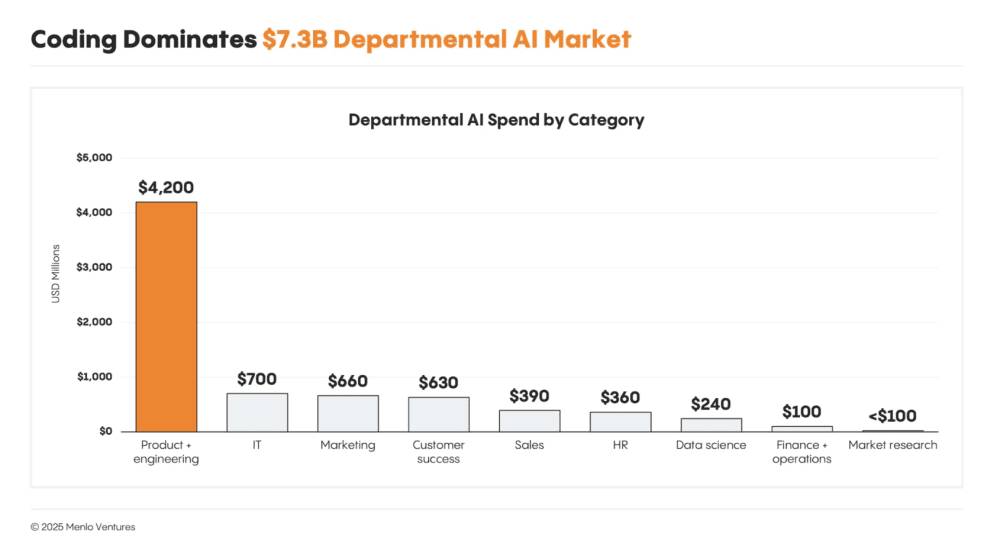
Enterprise AI has found its favorite department, and surprise: it is not the team making prettier slide decks or asking chatbots to summarize meeting notes. It is software development. According to recent enterprise AI spending analysis, coding now accounts for 55% of all departmental AI spend, representing roughly $4.0 billion out of a $7.3 billion departmental AI market. That is not a small “let’s test this for a quarter” budget. That is boardroom-level money with a hoodie on.
The message is clear: AI coding tools are no longer side toys for curious developers. They are becoming core infrastructure for modern engineering teams. From code completion and debugging to refactoring, test generation, documentation, and agentic workflows, AI is moving deeper into the software development lifecycle. Companies are not just asking, “Can AI write code?” They are asking, “How much faster can we build, ship, maintain, and modernize software if AI is built into the workflow from day one?”
This shift matters because software is the operating system of almost every business. Banks run on software. Hospitals run on software. Retailers, logistics firms, media companies, insurance carriers, manufacturers, and startups all depend on code to move faster than competitors. When AI proves useful in coding, it does not stay inside engineering for long. It changes product roadmaps, hiring plans, cloud budgets, security reviews, and even how executives think about innovation.
Why Coding Became AI’s First Big Enterprise Use Case
Coding is uniquely suited for generative AI because it is structured, testable, and expensive. Unlike vague business writing, code either runs or it does not. A function can pass tests, fail tests, compile, break production, or quietly create a bug that ruins someone’s Tuesday. This gives AI coding tools a feedback loop that many other AI use cases lack.
Software development also has a massive amount of public and private training context. Programming languages have documentation, examples, libraries, design patterns, error messages, and years of open-source discussion. A model can learn common ways to write a React component, query a database, create an API endpoint, or explain why a Python script is throwing an error. That does not make the model perfect, but it gives it a strong runway.
There is also a simple economic reason: developers are highly paid, software backlogs are endless, and companies always want more product shipped yesterday. If an AI assistant helps an engineer complete routine work faster, review legacy code more easily, or generate tests that would otherwise be skipped, the value can be immediate. This is why AI coding assistants moved from novelty to necessity so quickly.
From Autocomplete to AI Teammate
The first wave of AI coding felt like a smarter autocomplete. Developers typed a comment, and the tool suggested a line, a function, or a block of code. Helpful? Absolutely. Magical? Sometimes. Dangerous when accepted without reading? Also yes.
The newer wave is more ambitious. AI coding agents can inspect a codebase, edit files, run commands, generate tests, explain architecture, propose pull requests, and help with migrations. Tools such as GitHub Copilot, Cursor, Claude Code, Replit, OpenAI Codex-style agents, and other AI development platforms are pushing coding from “suggest my next line” toward “help me complete this task.”
That shift explains why spending is accelerating. Code completion is useful, but agents open the door to broader software work. A team can ask an AI assistant to investigate a bug, write a first draft of a feature, create documentation, convert old code to a newer framework, or generate test cases for a risky module. The developer still needs to supervise the work, but the starting point changes dramatically.
Where the AI Coding Money Is Going
The 55% figure includes a fast-growing mix of tools and platforms. Some budgets go toward seat-based coding assistants. Some go toward agentic development platforms. Some go toward internal tools built on large language models. And some go toward AI-powered application builders that help technical and semi-technical users create working software with less manual coding.
1. Code Completion and In-IDE Assistance
This remains the most familiar category. Developers use AI inside their integrated development environments to complete functions, suggest syntax, explain errors, and reduce repetitive typing. It is the “spellcheck for code” phase, except the spellcheck sometimes writes half the paragraph and occasionally invents a library that does not exist. Progress, with personality.
2. AI Coding Agents
Agents are where the market is getting especially interesting. Instead of waiting for a developer to ask for the next line, an agent can work through a task in steps. It can read files, make edits, run tests, respond to failures, and adjust its approach. This is why engineering leaders are paying attention. Agents promise not just faster typing, but a new operating model for software work.
3. Testing, QA, and Code Review
Writing code is only part of software development. Testing it, reviewing it, securing it, and maintaining it often take more time than the first draft. AI tools are increasingly used to generate unit tests, summarize pull requests, flag risky changes, and explain unfamiliar code. In many companies, the real ROI will come not from writing more code, but from catching problems earlier.
4. Legacy Modernization
Many enterprises have old systems that still run critical operations. Rewriting them manually is slow, expensive, and risky. AI can help translate code, explain outdated logic, generate documentation, and assist with incremental modernization. No serious company should hand a 20-year-old billing system to an AI agent and say, “Good luck, little robot.” But with human review, AI can make legacy work less painful.
Why AI Coding Spend Is Not Slowing Down
The growth is not just about hype. Several practical forces are pushing companies to spend more on AI coding tools.
First, adoption among developers is already high. Developer surveys show that a large majority of programmers are using or planning to use AI tools in their development process, with many professional developers using them daily. Once a tool becomes part of daily workflow, it becomes harder to remove. It moves from “nice to have” to “why is my editor suddenly less useful?”
Second, AI coding tools spread through product-led growth. Developers often discover tools independently, use them on real work, and then push companies to standardize access. This bottom-up adoption pattern is powerful because it does not begin with a six-month procurement theater performance starring spreadsheets and seventeen stakeholders named Greg.
Third, software demand keeps rising. Every department wants automation, dashboards, integrations, AI features, mobile experiences, better internal tools, and faster customer-facing releases. Engineering teams are under pressure to deliver more without multiplying headcount. AI coding tools promise leverage, and leverage is a word executives enjoy almost as much as “margin expansion.”
Fourth, models are getting better at software tasks. Improvements in reasoning, context handling, tool use, and repository-level understanding make AI more useful for real engineering work. The more capable these systems become, the more budget shifts from experimentation to standard operations.
The Catch: More Code Is Not Automatically Better Code
The biggest mistake companies can make is assuming that faster code generation equals better software delivery. It does not. More code can mean more bugs, more review burden, more security risk, and more maintenance unless the workflow changes around it.
Developers often complain that AI-generated answers are “almost right.” Almost right is fine when suggesting a lunch spot. It is less charming when configuring authentication, handling payment logic, or changing database migrations. AI can produce confident code that looks clean but misses edge cases, ignores internal standards, or creates subtle performance issues.
This is why the best companies are not simply buying AI coding licenses and declaring victory. They are redesigning software development around AI. That means stronger automated tests, clearer review rules, secure coding policies, better documentation, approved toolchains, and metrics that track business outcomes rather than vanity output.
In other words, AI can accelerate the factory, but the factory still needs quality control. Otherwise, the team ships faster and apologizes faster, which is not the dream.
How Smart Companies Are Measuring AI Coding ROI
Counting lines of code is a terrible way to measure AI success. A developer who deletes 500 lines of unnecessary code may create more value than one who generates 5,000 lines of fragile complexity. The better question is not, “How much code did AI write?” It is, “Did software delivery improve without increasing risk?”
Useful Metrics to Track
- Cycle time: How long does it take to move from task creation to production release?
- Pull request quality: Are AI-assisted changes easier or harder to review?
- Defect rate: Are bugs increasing, decreasing, or simply moving to different parts of the workflow?
- Test coverage: Are teams generating meaningful tests or just decorative green checkmarks?
- Developer satisfaction: Are engineers feeling more productive or more like babysitters for a caffeinated autocomplete?
- Security findings: Are AI-generated changes introducing vulnerabilities?
- Maintenance burden: Is the codebase becoming cleaner or more confusing over time?
The strongest AI coding programs measure the whole software lifecycle. They look at planning, coding, testing, review, deployment, incident response, documentation, and maintenance. That broader view matters because AI may save time in one area while creating work in another. If developers write code faster but QA and security teams are buried under new problems, the company has not gained much. It has simply moved the traffic jam.
What This Means for Developers
AI coding tools are not making developers irrelevant. They are changing what good developers spend time doing. The work is shifting from pure creation toward supervision, verification, architecture, integration, and judgment. A developer’s value increasingly comes from knowing what should be built, why it matters, how it fits the system, and whether the AI’s output is safe to trust.
This is a major skill shift. Developers need to become better at writing clear prompts, defining constraints, reading generated code critically, designing tests, reviewing security implications, and understanding systems at a higher level. Junior developers can use AI to learn faster, but they also need to avoid copying code they do not understand. Senior developers can move faster, but they must resist the temptation to treat AI output as automatically production-ready.
The best engineers will not be the people who blindly accept the most suggestions. They will be the people who can direct AI well, review it sharply, and use it to remove busywork without weakening the codebase.
Practical Examples of AI Coding Value
Imagine a product team needs a new customer dashboard. Without AI, developers may spend days building boilerplate components, wiring API calls, writing basic tests, and documenting endpoints. With AI, the team can generate a first draft faster, then focus human attention on business logic, user experience, permissions, performance, and edge cases.
Or consider a company migrating from an older framework to a newer one. AI can scan patterns, suggest conversions, explain deprecated code, and help generate repetitive migration patches. The final work still requires experienced review, but AI reduces the blank-page problem and speeds up the repetitive middle.
Another example is bug investigation. A developer can ask an AI assistant to summarize a stack trace, inspect related files, suggest likely causes, and propose a test that reproduces the issue. Even when the first answer is imperfect, it can shorten the path from confusion to hypothesis. Sometimes that is enough to save an afternoon and one dramatic sigh into a coffee mug.
Why Coding Is Only the Beginning
Coding has become the first major departmental AI spending winner because it has clear workflows, measurable outputs, and immediate pain points. But the pattern will not stop there. Once companies learn how to integrate AI into software development, they will apply similar lessons to IT operations, customer support, marketing, design, finance, HR, and industry-specific workflows.
The difference is that coding is teaching companies how to manage AI in serious production environments. It forces teams to answer hard questions: Who approves AI output? What data can tools access? How do we audit changes? What happens when an agent makes a mistake? Which tasks should be automated, and which need human ownership?
Those questions will shape the next phase of enterprise AI. Coding is not just a category of spend. It is a training ground for AI-native operations.
Experience Section: What It Feels Like When AI Coding Becomes Normal
When teams first adopt AI coding tools, the experience often starts with small wins. A developer asks for a helper function, a unit test, or a quick explanation of a confusing error. The tool responds instantly, and the reaction is usually some version of, “Wait, that actually worked?” This early stage is exciting because AI removes friction from annoying tasks. It helps with syntax, boilerplate, regular expressions, documentation, and small debugging puzzles. For many developers, it feels like having a patient teammate who never gets tired of explaining why the build failed.
Then comes the second stage: overconfidence. The team starts using AI for bigger tasks, and the output still looks impressive. A feature appears in minutes. A refactor seems clean. A test suite looks complete. But soon, someone notices that the tests are shallow, the feature misses a permission rule, or the refactor quietly breaks an integration. This is the “AI is brilliant, but also confidently weird” phase. It teaches teams an important lesson: AI coding is not magic automation. It is accelerated drafting.
The third stage is where mature habits develop. Developers begin writing better instructions. They provide context about architecture, naming conventions, testing requirements, security rules, and performance expectations. Teams create shared prompt patterns, repository guidance files, approved workflows, and review checklists. AI becomes less of a novelty and more of a disciplined assistant. This is when productivity gains become more realistic because the tool is no longer being used randomly. It is being used inside a system.
The fourth stage changes team culture. Engineers spend less time on repetitive scaffolding and more time reviewing, designing, and deciding. Product managers may prototype ideas faster. QA engineers may use AI to create broader test scenarios. DevOps teams may ask agents to explain deployment failures or generate infrastructure changes for review. The software team starts to feel less like a group of people typing every brick by hand and more like a crew directing powerful machinery. The machinery is useful, but nobody sane stands in front of it without a hard hat.
The fifth stage is strategic. Leaders stop asking whether developers should use AI and start asking how the entire software lifecycle should change. Should AI help write requirements? Should it generate test plans before code is written? Should every pull request include an AI summary? Should agents handle low-risk maintenance tickets? Should security scans become stricter because code volume is rising? These are no longer tool questions. They are operating-model questions.
The biggest experience lesson is that AI coding works best when people stay responsible. The teams that benefit most do not treat AI as a replacement for engineering judgment. They treat it as leverage. They let AI draft, search, summarize, transform, and suggest. Then humans decide, verify, simplify, and own the result. That balance is why AI coding spend keeps growing. Companies are not just buying faster typing. They are buying a new way to build softwareone where human creativity and machine speed finally share the same keyboard.
Conclusion
The fact that 55% of all departmental AI spend is now going to coding tells us where enterprise AI is delivering the clearest early value. Coding has the right mix of cost pressure, measurable output, technical structure, and daily user demand. That is why AI coding tools have moved so quickly from experimental assistants to serious budget items.
But the next phase will separate smart adopters from noisy adopters. Buying AI tools is easy. Building a better software delivery system around them is harder. Companies that combine AI coding assistants with strong engineering practices, clear governance, automated testing, security review, and meaningful productivity metrics will capture the most value. Companies that simply generate more code may discover that speed without discipline is just chaos wearing running shoes.
AI coding spend is not slowing down because the problem it solves is too important. Businesses need more software, developers need better leverage, and AI tools are becoming capable enough to reshape the workflow. The winners will not be the companies that ask AI to replace developers. The winners will be the companies that use AI to help developers build better software faster, safer, and with fewer meetings that could have been a commit message.