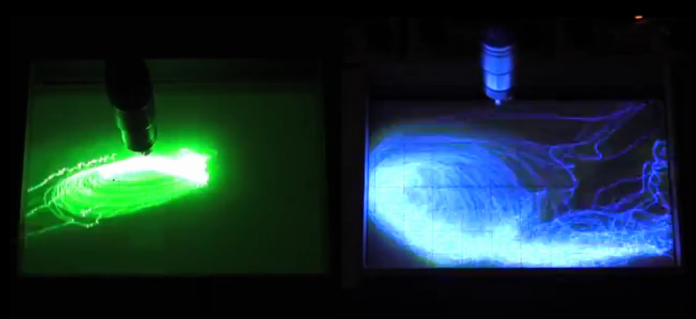
Note: This publication-ready article is original editorial content based on real information from contemporary music history, electronics education, and oscilloscope art references.
At first glance, the phrase “Pendulum Music for oscilloscope and photodiodes” sounds like something a brilliant engineer scribbled on a napkin after drinking coffee too close to a soldering iron. But behind the technical sparkle is a surprisingly elegant idea: motion becomes light, light becomes voltage, voltage becomes image, and the whole room becomes an instrument. It is part science demonstration, part sound art, part visual poetry, and part “please do not trip over that cable.”
The concept grows from Pendulum Music, Steve Reich’s famous 1968 process piece in which suspended microphones swing over loudspeakers, producing waves of feedback as gravity slowly brings the system to rest. Later artists and instrument builders, including Daniel Fishkin, explored ways to reinterpret that process using light-sensitive electronics and oscilloscopes. Instead of microphones and speakers alone, photodiodes can detect moving light, while an oscilloscope turns electrical signals into visible motion. The result feels like watching sound draw its own autobiography.
This article explores how pendulum music, oscilloscopes, and photodiodes connect; why the idea matters in experimental music; and how this unusual mix of art and electronics turns a simple swing into a performance.
What Is Pendulum Music?
Pendulum Music is one of those artworks that seems simple until you try to explain why it is so fascinating. Steve Reich, a central figure in American minimalism, created the piece in the late 1960s. Instead of writing melodies for violins, pianos, or flutes, he designed a situation. Microphones are suspended like pendulums. Loudspeakers are placed beneath or near them. Performers pull the microphones back, release them, and allow gravity to do the conducting.
As each microphone swings past a speaker, it enters a zone where acoustic feedback occurs. The sound is not “played” in the traditional sense. It is produced by the relationship between microphone position, speaker output, amplification, cable length, and time. The performer begins the process, but the system itself becomes the composer’s assistant. A very dramatic assistant, admittedlyone that speaks in whoops, chirps, pulses, and electronic squeals.
Process Music: When the Rules Become the Song
Reich’s early work often focused on audible processes. In process music, the listener can hear the structure changing over time. The point is not to hide the machinery behind the curtain. The machinery is the show. In Pendulum Music, the audience hears the swinging motion gradually slow down. The feedback pulses become less spaced out. Eventually, the microphones settle, and the sound becomes a continuous tone until the performers end the piece.
This makes Pendulum Music a beautiful example of art built from physical laws. Gravity, momentum, feedback, and phase relationships are not background details. They are the main characters. If traditional composition is a carefully written recipe, pendulum music is more like placing ingredients in a room and letting physics cook dinner.
Why Add an Oscilloscope?
An oscilloscope is an electronic test instrument that displays changing voltage over time. Engineers use it to troubleshoot circuits, measure waveforms, and spot signal behavior that a basic meter cannot show. Artists, however, looked at the glowing screen and thought, “That is nice, but what if it danced?”
In oscilloscope music, electrical signals are not only heard; they are seen. When an oscilloscope is set to XY mode, one signal controls the horizontal axis and another controls the vertical axis. The screen can display loops, knots, circles, ribbons, and Lissajous figures. These shapes are not random screensavers. They are visual expressions of the relationship between signals.
For pendulum-based performance, the oscilloscope adds a second layer of perception. The audience can watch movement become signal and signal become drawing. Instead of merely hearing periodic changes, viewers see them as luminous traces. The performance becomes a meeting point between concert, laboratory, and shadow puppet theaterexcept the puppets are electrons.
What Do Photodiodes Do in This Setup?
A photodiode is a semiconductor device that responds to light by producing current. In plain English, it is a tiny electronic eye. When more light hits it, the electrical behavior changes. With the right circuit, that change can be converted into a usable voltage signal.
That makes photodiodes perfect for translating moving light into electronic information. Imagine a pendulum carrying a small light source, or imagine a beam of light being interrupted, reflected, or shifted as the pendulum swings. A photodiode placed in the path of that light can detect changes in brightness. Those changes can become signals for an oscilloscope, audio system, or electronic instrument.
From Light to Voltage
The most important bridge between a photodiode and an oscilloscope is often an amplifier circuit. Photodiodes can produce very small currents, so artists and engineers frequently use a transimpedance amplifier to convert photocurrent into voltage. That voltage can then be displayed on an oscilloscope or processed as part of an audio-visual performance system.
In a pendulum music context, the photodiode does not simply “measure light.” It listens with its eyes. Every swing changes the amount, angle, or timing of light reaching the sensor. The oscilloscope then reveals those changes as moving shapes. The setup turns a pendulum into a visual oscillator, a sensor into a performer, and the screen into a glowing score.
Daniel Fishkin and the Light-Based Transcription
One of the most compelling modern reinterpretations of Reich’s idea is Daniel Fishkin’s transcription of Pendulum Music for oscilloscope and photodiodes. Fishkin, known for building unusual instruments and exploring sound installations, approached the original work through the language of light and electronic display. Instead of relying only on microphone feedback, the adaptation shifts attention toward optical feedback, sensing, and visualized signal behavior.
This is not a simple gadget remix. It is a thoughtful translation. The original piece asks: what happens when swinging microphones, loudspeakers, and feedback are allowed to expose a process? The oscilloscope-and-photodiode version asks a related question: what happens when a swinging physical system is translated into light-sensitive voltages that can be seen as well as heard?
That move matters because it preserves the spirit of the original while changing the medium. A musical idea becomes optical. Feedback becomes visual. The audience still witnesses time, decay, repetition, and gradual change. But now the performance has a glowing diagram of itself, as if the piece brought its own nervous system and plugged it into a screen.
How the Performance Works Conceptually
A pendulum is one of the simplest rhythmic systems in nature. Pull it back, release it, and it swings. The period of that swing depends mainly on the length of the pendulum. Longer pendulums swing more slowly; shorter ones swing faster. When several pendulums of different lengths are used, their cycles overlap in shifting patterns.
In the original Reich piece, those different pendulum lengths create overlapping feedback events. In a photodiode version, the same principle can produce overlapping light changes. Multiple pendulums may affect multiple sensors, or a single pendulum may create a repeating optical signal. The oscilloscope displays the resulting voltages as curves and movements.
The Role of Lissajous Figures
Lissajous figures appear when two periodic signals are plotted against each other. On an oscilloscope, these shapes can reveal frequency ratios, phase differences, and changes in timing. In music, they can make intervals visible. For example, two related tones may produce a stable shape, while slightly mismatched frequencies can create a figure that slowly rotates or beats.
In pendulum-based oscilloscope music, this visual language becomes especially expressive. The screen may show smooth loops when motion is regular, nervous wiggles when the signal is unstable, or slowly collapsing forms as the pendulum loses energy. The image is not decoration. It is evidence. It shows the performance thinking out loud.
Why This Matters in Experimental Music
Pendulum music for oscilloscope and photodiodes sits at the intersection of minimalism, sound art, kinetic sculpture, and DIY electronics. That intersection is crowded, weird, and absolutely worth visiting. The piece challenges the old idea that music must be organized around notes on a staff. Here, music is organized around systems.
This approach also changes the role of the performer. Instead of controlling every detail, the performer designs conditions and releases energy into them. The result is partly predictable and partly alive. A pendulum will follow physical laws, but small differences in release angle, cable tension, light alignment, sensor response, and room conditions can change the outcome.
That balance between control and chance is one reason experimental music remains exciting. It reminds us that art does not always need to behave like a polished pop single marching obediently toward a chorus. Sometimes art can swing, wobble, squeal, glow, and settle into stillness like a tired robot after a long day at the office.
Oscilloscope Music and the Beauty of Seeing Sound
Oscilloscope music has grown into a recognizable audiovisual practice. Artists use stereo signals to draw shapes directly on oscilloscope screens. The left channel may control horizontal motion, while the right channel controls vertical motion. When the same signal is sent to speakers, the audience hears the drawing and sees the sound at the same time.
This creates a tight relationship between audio and image. Unlike a music video, where visuals may be added later, oscilloscope music often makes image and sound inseparable. Change the sound, and the picture changes. Change the picture, and the sound must change too. It is a wonderfully strict bargain.
Pendulum music adds another physical layer to that relationship. The signals do not come only from software or synthesizers. They emerge from swinging bodies, light, and sensors. The performance becomes tactile. You can understand it with your ears, eyes, and common sense: something is swinging; something is sensing; something is glowing.
Practical Considerations for Artists and Students
For artists, students, or educators exploring this topic, the most important idea is not to chase complexity too quickly. The magic comes from clear relationships. A pendulum, a light source, a photodiode, an amplifier, and an oscilloscope can already create a rich demonstration of motion-to-signal translation.
Safety and simplicity matter. Low-voltage electronics are preferable for educational experiments. Sound levels should be kept comfortable, especially when feedback is involved. Bright light sources should be handled responsibly, and direct eye exposure should be avoided. The goal is to make art, not to turn the studio into a tiny insurance claim.
Good Questions to Ask Before Building a Version
Before designing a pendulum music setup, consider what you want the audience to notice. Is the focus on sound? On the oscilloscope image? On the physical pendulums? On the concept of feedback? A successful version does not need to do everything at once. In fact, the strongest performances often make one process extremely clear.
Ask how many pendulums are needed, whether the light source should move or remain fixed, how the photodiodes will be positioned, and whether the oscilloscope should display time-based waveforms or XY patterns. Each choice changes the personality of the piece. A single pendulum can feel meditative. Several pendulums can feel like a committee meeting held entirely by blinking machines.
Specific Example: A Simple Performance Scenario
Picture a darkened room. A small pendulum hangs from a stand, carrying a tiny light. Beneath it, two photodiodes are positioned so that the swinging light passes near them at different points in its arc. Each photodiode signal is amplified and sent to one channel of an oscilloscope in XY mode. As the pendulum moves, the oscilloscope trace stretches into loops and curves.
At the beginning, the motion is wide and energetic. The image expands across the screen. The sound, if the signals are also routed into an audio system, may pulse with a clear rhythm. As friction and air resistance reduce the swing, the visual form tightens. The audio pulse slows or softens. Eventually, the pendulum settles, and the screen becomes nearly still.
This scenario captures the heart of the idea. Nothing “dramatic” happens in the movie-trailer sense. There are no explosions, no dragons, and no heroic final guitar solo on a mountaintop. Yet the audience witnesses time becoming visible. That is its own kind of drama.
Why Audiences Respond to It
People respond to pendulum music because it is both mysterious and understandable. You do not need a PhD in electrical engineering to grasp the basic cause and effect. The object swings. The sound changes. The screen moves. At the same time, the details are deep enough to reward closer attention.
The piece also has humor. Reich himself recognized the odd charm of the original. Watching serious performers release microphones and let feedback bloom can feel delightfully absurd. The photodiode-and-oscilloscope version has a similar charm. It treats laboratory equipment with artistic seriousness while also admitting that glowing squiggles are simply fun to watch.
Experience Notes: Living With Pendulum Music, Oscilloscopes, and Photodiodes
Spending time with pendulum music is different from listening to a normal track on a playlist. A playlist asks, “Do you like this song?” Pendulum music asks, “Can you stay with a process long enough to notice it changing?” That difference can be surprisingly refreshing. In a world where most media grabs your attention by shouting, this kind of work earns attention by moving with patience.
The first experience many people have with oscilloscope music is visual wonder. The screen feels alive. A thin trace of light bends and folds into shapes that seem too graceful to come from voltage. Add photodiodes, and the wonder becomes more physical. Suddenly, the image is not just an electronic pattern. It is connected to a real object moving in space. You can point to the pendulum and then point to the screen. Cause and effect becomes a performance duet.
There is also a hands-on pleasure in adjusting the system. Move a photodiode slightly, and the signal changes. Shift the light angle, and the oscilloscope trace responds. Shorten the pendulum, and the rhythm becomes quicker. These adjustments feel less like operating a machine and more like tuning a living sculpture. The equipment has opinions, of course. Cables get fussy. Sensors pick up room light. The oscilloscope may display a shape that looks less like elegant minimalism and more like a confused spaghetti noodle. That is part of the charm.
For students, the experience can be especially powerful because it connects abstract concepts to sensory results. Frequency is no longer just a number in a textbook. It is the rate at which the pendulum returns. Phase is not just a diagram. It is the difference between two signals drawing a figure on a screen. Light intensity is not merely a data value. It is something that rises and falls as the pendulum crosses a sensor’s view. The learning happens through eyes, ears, and hands at the same time.
For artists, the setup encourages humility. You can plan the system, but you cannot command every tiny variation. The room participates. Gravity participates. The electronics participate. Even the audience participates by changing the atmosphere of attention. In that sense, pendulum music for oscilloscope and photodiodes is less about showing off technology and more about listening to relationships. It teaches that a performance does not need to be packed with notes to be rich. Sometimes one swinging object, one sensitive detector, and one glowing screen are enough to make time feel visible.
Conclusion: A Glowing Conversation Between Physics and Music
Pendulum Music for oscilloscope and photodiodes is not just a quirky technical phrase. It describes a fascinating artistic approach where motion, light, electronics, and sound form one connected system. Rooted in Steve Reich’s process-based thinking and expanded through modern sound art practices, this kind of work shows how simple physical actions can become complex sensory experiences.
The pendulum supplies rhythm. The photodiode translates light into electrical behavior. The oscilloscope reveals the signal as movement and shape. Together, they create a performance that feels both ancient and futuristic: ancient because it relies on gravity, futuristic because it glows like a message from a very musical laboratory.
For musicians, it offers a new way to think about composition. For electronics enthusiasts, it turns sensors and signals into art. For audiences, it provides the rare pleasure of watching sound become visible in real time. And for everyone else, it proves that sometimes the best instrument in the room is a swinging object with excellent timing.