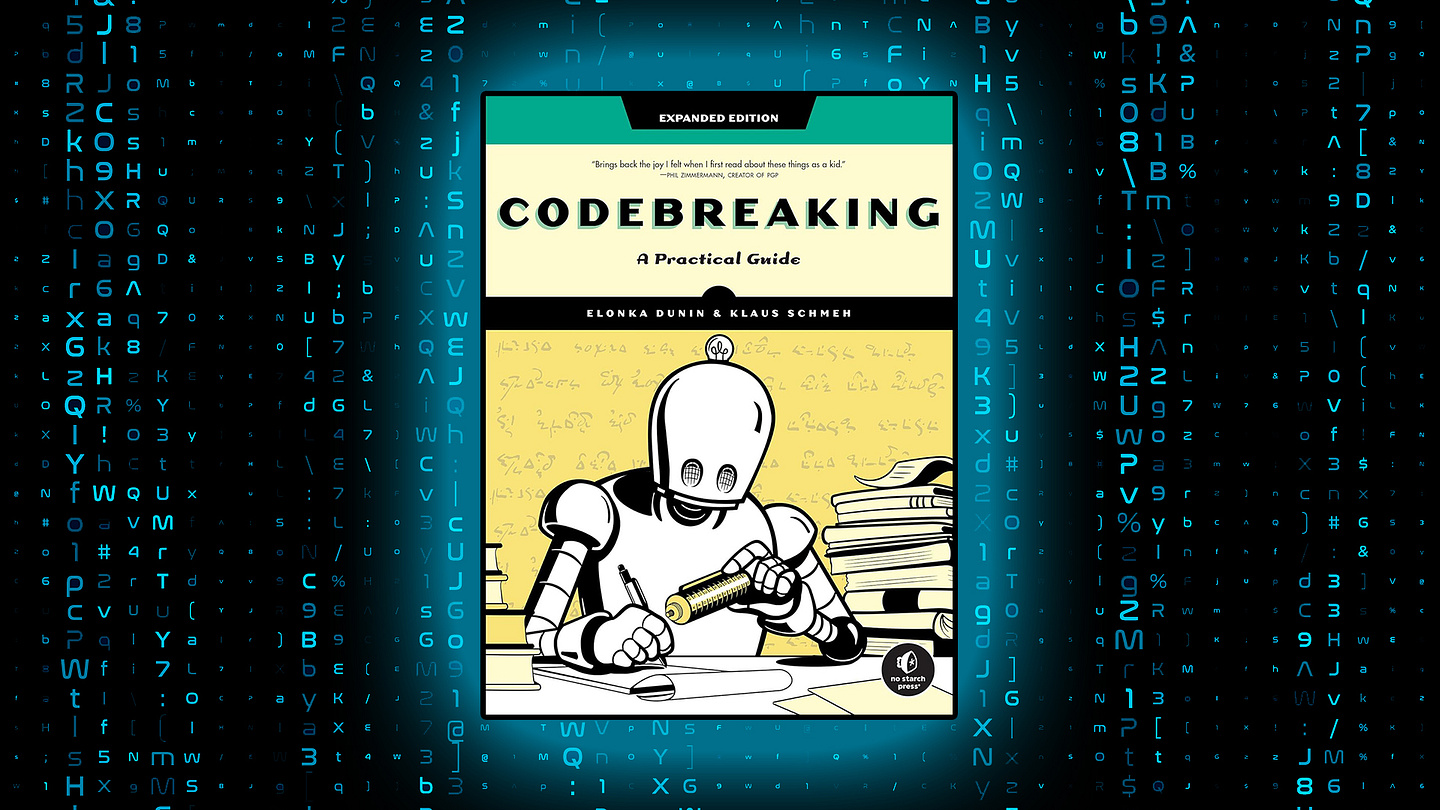
Codebreaking has a way of making ordinary people feel like secret agents, puzzle champions, and slightly suspicious librarians all at once. One minute you are staring at a row of random letters, and the next you are convinced the letter “X” is definitely an “E,” probably hiding a message about treasure, spies, or someone’s grocery list. That strange mix of logic, patience, and playful guessing is exactly why classic codebreaking remains so addictive.
Codebreaking: A Practical Guide by Elonka Dunin and Klaus Schmeh has become a useful doorway into this world because it treats cryptanalysis not as magic, but as a skill you can practice. The book focuses heavily on historical ciphers, real encrypted documents, practical solving methods, and the kind of pencil-and-paper reasoning that helps beginners understand what is happening behind the curtain. You do not need to be a mathematician in a dark room surrounded by red string. You need curiosity, a notebook, and a willingness to be wrong several times before being gloriously right.
This guide breaks down five beginner-friendly codebreaking tips inspired by the practical spirit of the book. The focus is on classic ciphers, cryptograms, substitution puzzles, transposition clues, and the small habits that help new solvers get unstuck. Whether you are solving a newspaper cryptogram, exploring Caesar ciphers, or dipping your toes into frequency analysis, these tips will help you think like a codebreaker without making your brain file a formal complaint.
What Is Codebreaking?
Codebreaking is the process of analyzing an encrypted or disguised message to recover its meaning without already knowing the key. In everyday conversation, people often use “code” and “cipher” interchangeably, but there is a useful difference. A code usually replaces whole words, phrases, or ideas with other symbols or terms. A cipher usually transforms letters or characters according to a rule, such as shifting letters, substituting one alphabet for another, or rearranging the order of a message.
For beginners, the best starting point is not modern military-grade encryption or advanced computer security. That is like learning to swim by being dropped into the ocean during a thunderstorm. Instead, start with historical and recreational ciphers: Caesar ciphers, monoalphabetic substitution ciphers, transposition ciphers, Vigenère ciphers, and cryptograms. These systems are approachable because they leave patterns behind. Your job is to notice those patterns and patiently squeeze meaning out of them.
Tip 1: Start by Counting What You See
The first rule of beginner codebreaking is simple: do not panic, and do not immediately guess words. Start by counting. A codebreaker’s first job is to observe the message before trying to solve it. How many symbols are there? Are the characters letters, numbers, punctuation marks, or strange symbols? Are they grouped in blocks of five? Are spaces preserved? Are there repeated patterns? Does the message look short, long, formal, messy, or deliberately arranged?
This counting stage may feel boring, but it is the cryptographic version of checking whether the door says “push” before you pull it for five minutes. Counting tells you what kind of puzzle you may be facing. If the message uses normal letters and keeps word spaces, it may be a simple substitution cipher. If the letters are grouped into equal blocks, the original spaces may have been removed to hide word boundaries. If numbers repeat in a predictable way, they may represent letters, positions, or a codebook system.
What to Count First
Begin with the total number of characters. Then count repeated symbols, short words, double letters, and recurring endings. In English, one-letter words are usually “A” or “I.” Common two-letter words include “of,” “to,” “in,” “it,” “is,” “as,” “at,” and “be.” Three-letter words such as “the,” “and,” “you,” “that,” and “for” can become powerful clues. Even before you know the message, the shape of the text begins whispering hints.
For example, suppose your ciphertext includes this pattern: “QZP QLL QZP.” Even without knowing the letters, you can see that the first and third words are identical. That tells you the same word appears twice. If this is a substitution cipher with spaces intact, you can begin asking which common three-letter word might repeat in that position. “The” is always a suspect, though it should never be trusted without evidence. In codebreaking, “the” is useful but dramatic, like a detective who shows up in every mystery wearing a trench coat.
Tip 2: Use Frequency Analysis Like a Detective, Not a Fortune Teller
Frequency analysis is one of the most famous beginner codebreaking techniques. The basic idea is that letters do not appear equally often in natural language. In English, letters such as E, T, A, O, I, N, S, H, and R appear frequently, while letters like Q, X, Z, and J are less common. If a substitution cipher replaces each plaintext letter with a different ciphertext symbol, the most common ciphertext symbol might represent one of the most common English letters.
Notice the word “might.” Frequency analysis is helpful, but it is not a vending machine where you insert a chart and receive the solution. Short messages can distort normal letter patterns. A message about “jazz quizzes” will not behave like a message about “the garden fence.” Proper names, unusual vocabulary, and missing spaces can all make the numbers weird. Still, frequency analysis gives you a starting map.
How Beginners Can Apply Frequency Analysis
Write down each unique symbol or letter in the ciphertext. Count how many times each one appears. Then list them from most common to least common. Compare the result with common English letter frequencies, but combine that comparison with word patterns. If the most common symbol appears in a three-letter repeated word shaped like “XYY,” it is probably not automatically “E.” You need the surrounding structure to guide you.
Here is a simple example. Imagine a ciphertext where “M” appears far more than any other letter, and you also see the word pattern “MZ” repeated many times. In English, a common two-letter word beginning with a frequent letter could be “to,” “in,” “is,” “it,” or “of,” depending on the pattern. If “M” also appears at the end of many words, maybe it is “E.” If it appears in the middle of common three-letter patterns, maybe it is “T” or “A.” The trick is to make hypotheses, test them, and erase them without emotional damage. Pencils were invented for exactly this kind of tiny heartbreak.
Tip 3: Look for Word Shapes and Repeated Patterns
Many beginner codebreakers make the mistake of staring at individual letters too long. Letters matter, but patterns matter more. In a simple substitution cipher, the same plaintext letter is always represented by the same ciphertext symbol. That means word shapes are preserved. A word like “letter” has the pattern 1-2-3-3-2-4 because the second and fifth letters match, and the third and fourth letters match. A word like “people” has a different repeated-letter shape. These patterns can narrow your choices quickly.
Repeated words are especially valuable. If a four-letter word appears several times, compare it with common English words such as “that,” “with,” “have,” “this,” “from,” and “were.” If a word ends with a repeated letter, think about “all,” “see,” “too,” “off,” or “will.” If a long word has a repeated ending, it may contain “-ing,” “-tion,” “-ed,” or “-er.” Codebreaking often feels like playing Wordle with more paperwork and fewer green squares.
Pattern Examples That Help
Suppose you find a three-letter encrypted word with the pattern “ABA,” meaning the first and third letters are the same. Common English words with that pattern include “did,” “mom,” “dad,” “eye,” and “pop.” In a normal sentence, “did” may be more likely than “pop,” unless the message is about soda, music charts, or an unusually suspicious balloon. Context matters.
Now imagine a word pattern like “ABCCDE.” That shape could match words such as “little” or “coffee,” depending on the exact repeated positions. When you combine word shape, letter frequency, and sentence context, you begin to build a network of clues. No single clue solves the whole cipher, but each one removes a few wrong paths. That is progress.
Tip 4: Use Cribs and Context Clues
A “crib” is a guessed word or phrase that may appear in the plaintext. Cribs are incredibly useful because messages are rarely written in a vacuum. A military message might include ranks, dates, locations, or weather terms. A puzzle message might include a quote, a common phrase, or a theme. A coded postcard might include greetings, names, or travel details. If you know anything about the source, author, date, or purpose of the message, use it.
Beginners sometimes think using context is cheating. It is not. Real codebreakers have always used context. Language is full of habits. People repeat phrases. Organizations use standard formats. Letters begin with greetings and end with signatures. Dates appear in predictable places. Even punctuation can reveal personality. Cryptanalysis is not only math; it is also reading behavior.
How to Use a Crib Safely
The danger with cribs is falling in love with a guess. If you decide that a word must be “secret,” you may bend every other clue until the puzzle collapses into nonsense. Use cribs as tests, not commandments. Place the guessed word under the ciphertext and see whether the letter relationships work. In a substitution cipher, one ciphertext symbol cannot stand for two different plaintext letters. If your crib breaks that rule, politely escort it out of the investigation.
For example, if you suspect a message contains “ATTACK,” check whether the ciphertext word has the same pattern: A-T-T-A-C-K has the pattern 1-2-2-1-3-4. If the encrypted word has no matching repeated structure, your crib is probably wrong. This pattern check saves time and protects you from the classic beginner trap: solving the message you wish existed instead of the one actually on the page.
Tip 5: Keep a Solving Log and Test One Change at a Time
Codebreaking rewards organized thinking. A beginner may make five good guesses, forget three of them, accidentally reverse two, and then blame the cipher for being “impossible.” The cipher may indeed be difficult, but your notebook should not be helping it. Keep a solving log. Write down symbol counts, possible substitutions, rejected guesses, confirmed letters, and open questions.
Testing one change at a time is especially important. If you decide that “Q” equals “T,” fill it in and see what happens. Do not simultaneously decide that “Z” equals “H,” “M” equals “E,” and the whole thing was written by a pirate named Kevin. Too many guesses at once create confusion. Good codebreaking is a slow conversation with the evidence.
Build a Simple Workflow
Start with observation. Count symbols and note patterns. Next, try frequency analysis. Then inspect short words and repeated words. After that, test possible cribs. Finally, revise your alphabet or working key as new evidence appears. If you are using software tools, use them to support your reasoning, not replace it. Tools can count, sort, and test possibilities quickly, but the human solver still needs to judge which result makes linguistic sense.
This workflow also helps you avoid frustration. When you get stuck, you can return to the process instead of simply staring harder. Staring harder is rarely a breakthrough strategy, although it does make you look intense.
Common Beginner Mistakes in Codebreaking
The first common mistake is assuming every cipher is a simple substitution cipher. Many beginner puzzles are, but not all of them. Some ciphers rearrange letters instead of replacing them. Others use multiple alphabets, numbers, coordinates, symbols, or hidden text. If your substitution guesses keep failing, consider whether you are dealing with transposition, polyalphabetic encryption, or a code system rather than a simple letter swap.
The second mistake is trusting frequency analysis too much. Letter frequency is a clue, not a court ruling. Short messages are especially unreliable. A 30-character ciphertext may not contain enough data for a clean frequency pattern. In that case, word shapes and context may matter more than raw counts.
The third mistake is ignoring the language of the plaintext. English has habits. It favors certain letter combinations such as “th,” “he,” “in,” “er,” “an,” and “re.” It also uses common endings such as “-ing,” “-ed,” “-tion,” and “-ly.” When your proposed solution creates impossible letter clusters, pay attention. The cipher may be telling you your guess needs retirement.
Why Classic Codebreaking Still Matters
Classic codebreaking teaches more than how to solve old puzzles. It builds pattern recognition, logical reasoning, patience, and skepticism. These skills apply far beyond cryptograms. When you analyze a cipher, you learn to separate evidence from assumption, test theories, and revise your thinking. That is useful in research, programming, cybersecurity, data analysis, and everyday problem-solving.
It also gives modern cryptography a human story. Today’s secure systems rely on advanced mathematics, formal standards, and carefully designed algorithms. But the roots of cryptography include handwritten messages, cipher disks, substitution alphabets, wartime communications, puzzle clubs, and brilliant people noticing tiny patterns. Learning beginner codebreaking connects you to that history in a hands-on way.
Practice Exercise: A Beginner-Friendly Approach
Try solving a simple substitution cryptogram using this process. First, copy the ciphertext neatly. Second, count letter frequency. Third, circle one-letter, two-letter, and three-letter words. Fourth, mark repeated words. Fifth, test possible common words such as “the,” “and,” “that,” or “you.” Sixth, fill in only the substitutions that continue to make sense across the whole message. Seventh, keep a list of guesses you rejected so you do not accidentally invite them back like troublesome party guests.
As you practice, choose puzzles with preserved spaces before moving to harder examples. Then try messages with spaces removed. After that, experiment with Caesar ciphers, Vigenère ciphers, route transpositions, and historical puzzle systems. The goal is not to solve everything instantly. The goal is to become comfortable with uncertainty. Codebreaking begins when you can look at nonsense and say, “Interesting. Let’s see what kind of nonsense this is.”
of Practical Experience: What Beginner Codebreaking Feels Like in Real Life
The first real experience many beginners have with codebreaking is not triumph. It is confusion wearing a tiny hat. You open a cryptogram, see a wall of letters, and immediately wonder whether everyone else received a secret instruction manual. That feeling is normal. In fact, it is part of the fun. A cipher is designed to resist casual reading, so the first few minutes should feel uncertain. The key is to turn that uncertainty into small, manageable tasks.
One useful habit is to treat the puzzle like a messy room. You do not clean a room by screaming at the laundry. You start with one corner. In codebreaking, that corner might be counting the most common letter, identifying repeated words, or marking all two-letter words. Once you have one small clue, the puzzle becomes less intimidating. You may not know the message yet, but you know something about it, and that is enough to begin.
Another experience beginners quickly discover is that wrong guesses are not failures. They are information. If you guess that a three-letter word is “the” and it creates impossible results elsewhere, that is useful. You have eliminated a tempting path. Good solvers are not people who never guess wrong. They are people who notice when a guess is wrong and adjust without taking it personally. The puzzle is not insulting you. It is merely being encrypted, which is its whole job.
Working by hand can also change the experience. Digital tools are helpful, but writing substitutions on paper forces you to slow down and see relationships. You notice that the same symbol appears at the end of several words. You spot a doubled letter. You realize that a guessed vowel makes three surrounding words suddenly look English. These little moments create momentum. The page starts as a locked door and slowly becomes a conversation.
Group solving is another surprisingly powerful experience. One person may notice frequency patterns, another may spot likely phrases, and someone else may recognize a historical reference. Codebreaking can feel solitary, but it often improves when different minds bring different instincts. Even a beginner can contribute by asking simple questions: “Why can’t that word be ‘that’?” or “Does this repeated pattern matter?” Often, the question that sounds basic is exactly the question that opens the puzzle.
Patience matters most when the cipher reaches the awkward middle stage. The beginning is exciting because every mark feels new. The end is exciting because words are appearing. The middle is where you have some letters, many blanks, and a growing suspicion that the puzzle is personally enjoying your discomfort. This is where a solving log helps. Return to your counts. Recheck your assumptions. Look for endings. Try a new crib. Take a short break. Many solutions appear after your brain has had time to quietly rearrange the evidence in the background.
Over time, beginner codebreaking becomes less about “cracking the code” dramatically and more about learning how messages behave. English has rhythm. Ciphers preserve or distort that rhythm in different ways. The more puzzles you solve, the more familiar those rhythms become. You start noticing that certain patterns feel like common words, that certain letter pairs are suspicious, and that some guesses are too convenient to trust. That instinct is not magic. It is practice.
The best experience of all is the moment when the message begins to read back to you. A few letters become a word. A word becomes a phrase. A phrase becomes a sentence. Suddenly the meaningless text has a voice. That reveal is why people keep solving. Codebreaking gives you the pleasure of discovery, the discipline of logic, and the comedy of arguing with the alphabet until it finally cooperates.
Conclusion
Codebreaking: A Practical Guide reminds beginners that cryptanalysis is not reserved for geniuses in movies who solve impossible puzzles while dramatic music plays. It is a practical craft built from observation, pattern recognition, testing, and revision. Start by counting what you see. Use frequency analysis carefully. Study word shapes and repeated patterns. Bring in context and cribs without becoming stubborn. Keep a solving log so your best ideas do not vanish into the fog.
Most importantly, enjoy the process. Codebreaking is a rare hobby where being confused is not a sign that you are doing it wrong. It is the doorway in. Every solved cipher teaches you to see language differently, think more clearly, and appreciate the clever ways humans have hidden messages throughout history. And if your first few attempts look like alphabet soup, congratulations. Soup is still a beginning.
SEO Tags
Note: This article is original, written in standard American English, and synthesized from reputable educational, reference, publisher, museum, and cryptography resources for web publication.