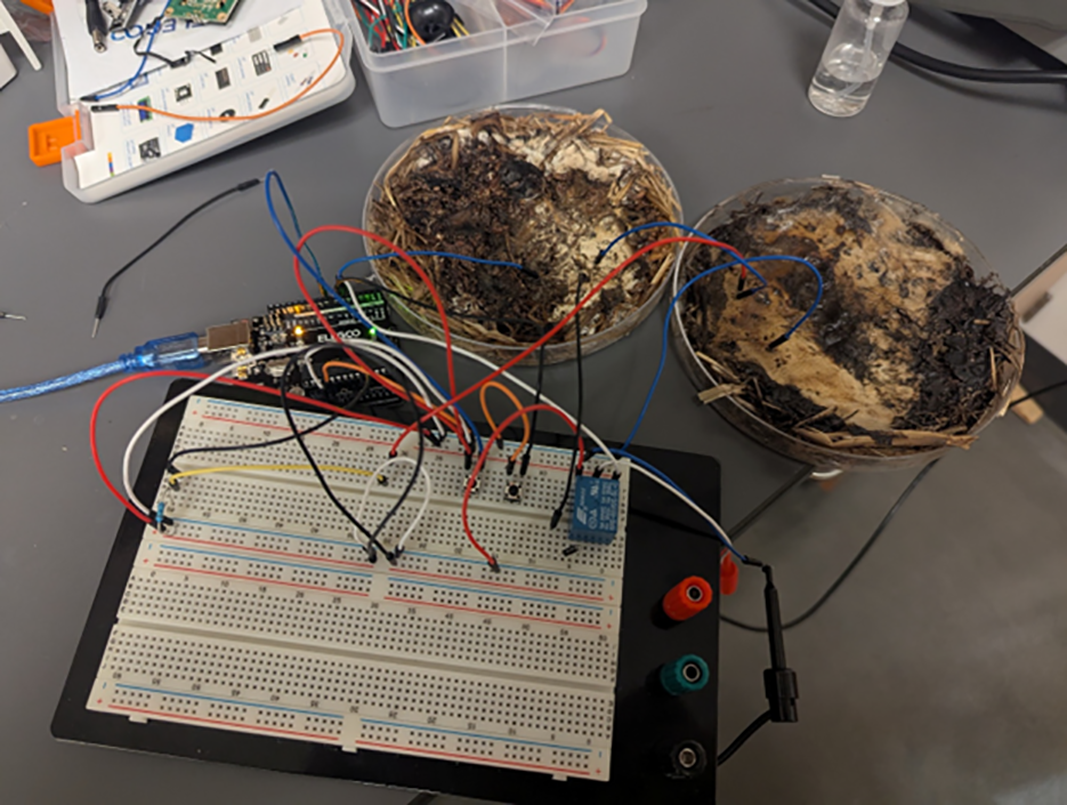
For most of human history, mushrooms were asked to do fairly humble work: improve pasta, appear mysteriously on lawns, and make hikers nervous. Now, in a plot twist worthy of science fiction with a compost bin, researchers are exploring whether fungi can help computers remember. Yes, mushrooms as computer memory is a real research topic, not a headline generated by a bored refrigerator.
The idea sounds odd until you look under the cap. A mushroom is only the visible fruiting body of a much larger organism. Beneath it is mycelium: a branching network of tiny fungal threads called hyphae. Mycelium spreads, adapts, responds to its environment, transports nutrients, and produces electrical activity. To computer scientists interested in brain-inspired hardware, that is not just biology. It is a possible platform for computation.
In recent years, researchers have shown that fungal networks can conduct electrical signals, produce spike-like activity, and even behave in ways similar to memristors, a type of electronic component often described as a “memory resistor.” A memristor changes its resistance based on past electrical activity. In simple terms, it remembers what happened to it. That makes it valuable for neuromorphic computing, a field that tries to build computer systems inspired by the human brain.
So no, your laptop will not be powered by a shiitake sandwich tomorrow morning. But the science behind fungal computing is serious, surprisingly elegant, and potentially important for sustainable technology.
What Does “Mushrooms As Computer Memory” Actually Mean?
When people hear “mushroom memory,” they may imagine data being stored in a portobello like files in a flash drive. That is not quite the situation. Scientists are not uploading vacation photos into a mushroom cap. Instead, they are studying whether fungal materials, especially mycelium, can act like electronic memory components.
Traditional computer memory is built from carefully manufactured materials such as silicon, metals, oxides, and increasingly specialized nanoscale structures. These materials are powerful, fast, and reliable, but they can also be energy-intensive to produce. Some require rare or difficult-to-source elements. Others create electronic waste that refuses to biodegrade with anything resembling good manners.
Fungal computer memory takes a very different path. Mycelium can be grown using low-cost organic matter. It forms complex networks naturally. It responds to voltage, moisture, pressure, chemicals, and other environmental changes. Under the right conditions, it can show electrical behaviors that resemble memory, switching, and signal processing.
The most exciting research focuses on using fungi as organic memristors. A memristor is useful because it combines memory and processing in one component. Instead of storing data in one place and processing it in another, a memristor can help do both. That matters because moving data around is one of the big energy drains in modern computing. If hardware can remember and compute in the same location, it may reduce power consumption.
The Science Behind Fungal Memory
Mycelium: The Living Network Under the Mushroom
Mycelium is often compared to roots, but that comparison is only partly correct. It is more like a living network. It grows through soil, wood, compost, or lab materials, forming fine threads that connect, branch, and reorganize. In nature, fungal networks help decompose organic matter, interact with plants, and respond to changing environmental conditions.
That network-like structure is one reason scientists are interested in fungi for unconventional computing. Computers rely on networks of components. Brains rely on networks of neurons. Mycelium is also a network, although it was not designed to run spreadsheets, stream video, or panic when a browser opens 47 tabs.
Researchers have measured electrical activity in several fungal species. These signals can appear as spikes, oscillations, and changing resistance patterns. Some studies have examined whether fungal electrical spikes might carry information in ways that can be modeled or interpreted. The point is not that mushrooms are secretly typing emails underground. The point is that fungi produce measurable electrical activity that may be useful for sensing, decision-making, and bioelectronic devices.
Memristors: The Memory Resistors That Remember
A memristor is an electronic component whose resistance depends on its history. If current flows through it, its electrical state changes. When the current stops, the component can retain some memory of that previous state. This makes memristors attractive for artificial intelligence hardware, low-power devices, edge computing, and brain-like systems.
In conventional electronics, memristors may be made from metal oxides or advanced materials that require careful fabrication. Fungal memristors suggest another route: grow a biological material, condition it, connect it to electrodes, and use its natural electrical properties. That sounds simple, but the lab work is delicate. Moisture, structure, temperature, growth stage, and electrode placement can all affect performance.
Recent research using shiitake mycelium has shown that fungal materials can be trained and preserved through dehydration while retaining memristive behavior. In experiments, mushroom-based memristors have demonstrated switching behavior at thousands of cycles per second with strong accuracy under tested conditions. That does not make them ready to replace the memory in a gaming PC, but it does prove the concept is more than a cute science fair poster with a damp mushroom taped to a wire.
Why Shiitake Mushrooms Are Getting Attention
Shiitake mushrooms are familiar in kitchens, but they are also useful in laboratories. Their mycelium can be cultivated, handled, dried, and rehydrated in controlled ways. Researchers have used shiitake mycelium to create organic memory-like devices that respond to electrical signals.
One major advantage is sustainability. Fungal materials can be grown from inexpensive biological feedstocks. They are biodegradable. They do not require the same kind of high-temperature, high-purity industrial processing used in many conventional semiconductor materials. In a world drowning in e-waste and increasingly hungry for computing power, that matters.
Another advantage is adaptability. Biological materials are messy, but sometimes that messiness is useful. Mycelium can form complex structures that resemble the tangled architectures needed for brain-inspired computing. It can also interact with the environment in ways that traditional chips cannot. This makes fungi interesting not only for memory but also for sensors, adaptive materials, and smart biological interfaces.
Shiitake mycelium is not magic. It has limitations. It is slower and less predictable than silicon. Its performance can vary depending on growth conditions and preparation. It is also not suitable for every computing task. But in specialized environments where low cost, biodegradability, resilience, or sensing ability matters, fungal electronics could become valuable.
How Fungal Computer Memory Could Work
A basic fungal memory device begins with growing mycelium under controlled conditions. The fungal network is then integrated with electrodes. Researchers apply electrical signals and measure how the material responds. If the resistance changes based on previous stimulation and retains that change, the material may behave like a memristive system.
In practical terms, the device must switch between states. Those states can represent information. In digital electronics, information is often simplified into 0s and 1s. In neuromorphic systems, memory can be more analog and flexible, closer to the way synapses strengthen or weaken in the brain. Fungal memristors may be useful in this second category because their responses are not always perfectly binary. Instead, they can show gradual, adaptive electrical behavior.
This is why scientists often connect mushroom computing with neuromorphic computing. The goal is not necessarily to build a mushroom laptop. The more realistic goal is to create devices that learn, adapt, sense, and process information using very little energy.
Why Researchers Care About Mushroom-Based Memory
1. Sustainability
Modern computing is powerful, but it has an environmental cost. Data centers consume enormous amounts of electricity. Devices become obsolete quickly. Electronic waste piles up. Manufacturing advanced chips requires cleanrooms, energy, chemicals, and complex supply chains.
Mushroom-based memory offers a possible alternative for some applications. Fungal materials can be grown rather than mined or etched. They can biodegrade more easily than many electronic components. If researchers can improve stability and performance, fungal electronics could support greener computing systems.
2. Low-Power Computing
Memristors are attractive because they can reduce the need to move data back and forth between memory and processors. This could lower energy use. Biological memristors may push that concept further by using materials that naturally respond to electrical patterns.
Low-power computing is especially important for sensors, wearable devices, environmental monitoring, space systems, and remote electronics. A device that can sense, remember, and process information with minimal power could be useful in places where batteries are hard to replace and outlets are just a beautiful dream.
3. Neuromorphic Computing
The brain is extraordinarily efficient. It processes complex information using far less energy than many artificial systems. Neuromorphic computing tries to imitate some of that efficiency by building hardware that works more like neural networks in the biological sense, not just software models running on graphics cards.
Fungal networks produce spike-like activity and adaptive responses. That makes them interesting for experiments in unconventional computing. They may help researchers develop new ways to process information that are less rigid than traditional silicon circuits.
4. Biodegradable Electronics
The future will likely include more sensors, not fewer. Smart homes, farms, factories, hospitals, roads, forests, and oceans may all use distributed sensing devices. If every sensor becomes permanent trash, that is a problem. Biodegradable electronics could help reduce long-term waste.
Mycelium-based devices could be part of this trend. A fungal sensor or memory component may not need to last for decades. It may only need to function long enough to collect data, support a temporary system, or operate in a disposable medical or environmental application.
Real-World Examples and Research Directions
The most visible recent example involves researchers experimenting with shiitake mycelium as a sustainable memristor material. The work showed that fungal networks could be interfaced with electrodes, trained through electrical stimulation, and preserved through dehydration while retaining memory-like properties. This was an important step because it suggested that fungi may be more robust than many people expect.
Other research has explored fungal electrical spiking, logical circuits in living mycelium, mycelium-bound composites, and fungal materials that respond to pressure, light, and chemical changes. Scientists working in unconventional computing have proposed that fungi may be used for sensing, decision-making, and adaptive architecture. Imagine a building material that not only insulates a wall but also senses moisture or structural stress. That is less “haunted house” and more “biological smart infrastructure.”
Fungal computing also overlaps with the broader field of bioelectronics. Researchers are investigating living materials, organic circuits, soft sensors, and biodegradable components. Fungi are appealing because they grow easily, tolerate varied environments, and form useful networks without needing a tiny construction crew wearing lab coats.
What Are the Biggest Challenges?
Consistency
Silicon chips are manufactured with extreme precision. Fungi are alive, or at least biologically grown, and living systems have opinions. They grow differently depending on nutrients, humidity, temperature, and contamination. For mushroom memory to become useful, researchers must learn how to produce reliable materials with predictable electrical properties.
Speed
Fungal devices are not competing with the fastest semiconductor memory. Conventional computer memory operates at speeds and densities that biological materials cannot currently match. The best use cases for fungal memory may involve low-power, specialized, adaptive, or environmentally friendly systems rather than mainstream high-performance computing.
Durability
Fungal materials must survive handling, storage, electrical stimulation, and real-world conditions. Dehydration may help preserve some devices, but long-term reliability is still a major question. Engineers need to know how these materials age, fail, and recover.
Integration
Even if fungal memory works in a lab, it must connect to existing electronics. That means developing interfaces, packaging methods, signal-processing tools, and manufacturing standards. A mushroom memristor is exciting, but it still has to talk to the rest of the machine without acting like a mysterious woodland oracle.
Could Mushrooms Replace Silicon?
Not in the broad sense. Silicon is fast, scalable, mature, and deeply embedded in global technology. Mushrooms will not replace the processor in your phone next year, and nobody should throw a handful of cremini into a motherboard slot in the name of innovation.
A more realistic future is hybrid computing. Fungal materials could be used alongside traditional electronics for specific roles. They might serve as biodegradable sensors, organic memory components, experimental neuromorphic devices, or adaptive interfaces between biological and digital systems.
This is how many new technologies begin. They do not immediately replace everything. They find niches where their unusual strengths matter. Fungal computing’s strengths may include sustainability, low-cost growth, environmental responsiveness, and complex natural network formation.
Why This Topic Matters Now
The world wants more artificial intelligence, more sensors, more automation, and more connected devices. That means more hardware. At the same time, society is becoming more aware of the environmental cost of electronics. These two trends are on a collision course.
Mushrooms as computer memory sits at the intersection of several big questions. Can we grow electronic materials instead of mining them? Can computers become more energy-efficient by imitating biology? Can biodegradable devices reduce e-waste? Can living or once-living materials perform useful computing tasks?
The answers are still developing, but the research is valuable because it expands what we consider possible. Computing does not have to be only rigid, metallic, and rectangular. It can also be organic, adaptive, soft, and grown. That shift in imagination may be as important as any single device.
Experiences and Reflections on Mushrooms As Computer Memory
The first time most people hear about mushrooms as computer memory, their reaction is usually a pause, a blink, and then the face people make when someone says a goldfish is doing taxes. It sounds absurd because we are trained to think of computers as clean, cold, and metallic. Mushrooms feel earthy, damp, and suspiciously likely to appear in soup. Yet the more you learn about mycelium, the less strange the idea becomes.
One useful way to experience this topic is to think about an old forest after rain. The visible mushrooms are only small signs of something bigger happening underground. Beneath the soil, mycelium is exploring, connecting, reacting, and reorganizing. It is not a brain, but it is a responsive network. That image helps explain why scientists are curious. Computing, at its deepest level, is not only about shiny devices. It is about information moving through systems.
Another striking experience comes from comparing fungal computing with everyday electronics. A phone feels magical because it is polished and fast, but its materials come from industrial processes that are anything but magical. Mining, refining, shipping, manufacturing, and disposal all leave footprints. A fungal memory device, by contrast, begins with growth. It suggests a different relationship with technology: less extraction, more cultivation.
Of course, the romantic version of mushroom computing needs a reality check. Biological materials are unpredictable. A lab-grown fungal device is not the same as a factory-made chip. Moisture changes things. Temperature changes things. Even the exact structure of the mycelium can change performance. Anyone who has ever tried to keep a houseplant alive knows that biology does not always respect engineering schedules.
Still, that unpredictability can be part of the lesson. Traditional computing prizes control. Biological computing explores adaptation. A fungal memory system may never beat silicon at being silicon. Its value may come from being something else entirely: a low-power, biodegradable, environmentally sensitive material that can participate in computation.
For students, writers, engineers, and curious readers, mushrooms as computer memory is a reminder that innovation often begins by asking a slightly ridiculous question with a straight face. What if a fungus could remember? What if a living network could help process signals? What if the future of computing is not only built in cleanrooms but also grown in trays?
The topic also encourages humility. Nature has been solving problems for billions of years without venture capital, product launches, or motivational LinkedIn posts. Fungi recycle forests, partner with plants, survive harsh environments, and build vast hidden networks. Using them in computing is not about pretending mushrooms are tiny laptops. It is about recognizing that biological systems may contain design principles we have barely started to understand.
In practical terms, the best attitude is cautious excitement. Mushroom memory is not ready to replace conventional RAM. It is not a consumer product. It is early-stage research with real promise and real limitations. But it points toward a future where electronics may be softer, greener, and more integrated with the natural world.
And if that future arrives, perhaps the phrase “my computer has mushrooms” will no longer mean someone spilled lunch into a keyboard. It may mean the machine is part of a new generation of sustainable, bio-inspired technologyone that remembers not with silicon alone, but with the quiet electrical behavior of mycelium.
Conclusion
Mushrooms as computer memory may sound like a joke hiding in a science journal, but it is a legitimate research direction in bioelectronics and unconventional computing. Fungal mycelium can form complex networks, conduct electrical signals, and display memory-like behavior under controlled conditions. Studies involving shiitake mycelium and other fungi suggest that mushroom-based memristors could one day support low-power neuromorphic systems, biodegradable sensors, and sustainable computing devices.
The technology is still young. It faces challenges in speed, consistency, durability, and integration with existing electronics. But its potential is fascinating. Instead of forcing all computing to follow the same silicon path, fungal memory invites researchers to explore a more organic route. The result may not be a mushroom-powered laptop, but it could be something equally important: a greener, more adaptive way to think about the future of information technology.
Note: This article is based on real research and reporting about fungal computing, mycelium-based memristors, neuromorphic hardware, and bioelectronic materials. It is written as original web-ready content without source links or citation markers.


