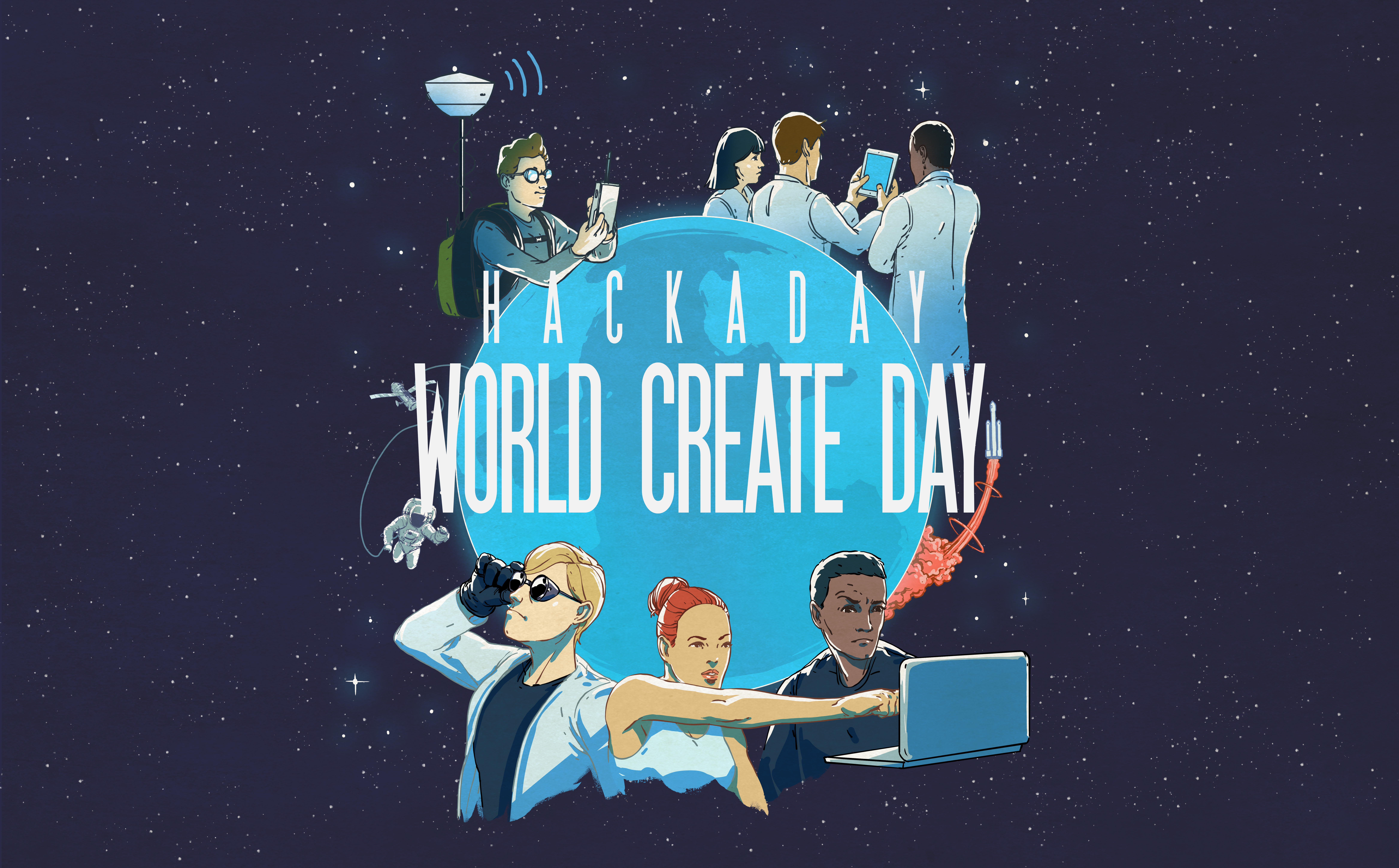
World Create Day is what happens when the internet’s favorite hardware hackers decide that comment sections are great, but solder fumes, coffee, and real people in one room are even better.
What Is World Create Day?
World Create Day is a community-driven Hackaday event built around a simple but powerful idea: gather makers, hackers, engineers, students, designers, tinkerers, and curious neighbors in the same physical space and create something useful. It is not a polished trade show where everyone pretends their prototype worked on the first try. It is closer to a neighborhood invention jam, where half-finished ideas are welcome, cardboard mockups are respected, and someone always knows where the missing USB cable is hiding.
The event grew from Hackaday’s larger mission of celebrating hardware creativity and open engineering. Instead of keeping projects trapped inside private notebooks or lonely workbenches, World Create Day encourages people to meet, brainstorm, build, document, and share. In many cases, the event has served as a launchpad for Hackaday Prize entries, especially projects aimed at solving real-world problems through open hardware, electronics, software, mechanics, design, and community collaboration.
At its heart, World Create Day is not about showing off expensive tools. It is about momentum. A person walks in with an idea for a water-level sensor, assistive device, environmental monitor, educational robot, modular synthesizer, low-cost medical tool, or delightfully weird interactive fish. A few hours later, that idea has sketches, a team, a parts list, maybe a rough prototype, and definitely at least one dramatic debugging story.
Why Hackaday Turned a Global Community Into a Local Event
Hackaday has always lived in the fascinating space between online publishing and hands-on engineering culture. The site highlights unusual builds, reverse engineering adventures, embedded systems, robotics, open source hardware, 3D printing, radio experiments, and projects that make normal people say, “Wait, you built that in your garage?” Hackaday.io expanded that culture into a project-hosting community where makers can document builds, collaborate, and learn from one another.
But even the best online community has a limitation: sometimes you need another human being standing next to you saying, “Have you tried turning it around?” World Create Day solves that problem by moving the Hackaday spirit into local hackerspaces, makerspaces, workshops, universities, community labs, and living-room-level gatherings. It turns scattered readers into real teams.
This matters because hardware is physical. A software project can often begin with a laptop and a dramatic playlist. Hardware needs parts, tools, measurements, enclosures, power, safety checks, and a patient person who understands why smoke is rarely a feature. When people meet in person, they can share tools, spot mistakes faster, teach beginners, and combine skills that would be hard to coordinate through messages alone.
The Hackaday Prize Connection
World Create Day has often been closely tied to the Hackaday Prize, a global hardware design challenge focused on impactful innovation. The Prize has encouraged open source hardware projects that address education, assistive technology, environmental challenges, scientific tools, and other practical needs. World Create Day fits perfectly into that ecosystem because it gives people a friendly starting line.
A participant does not need to arrive with a finished invention. In fact, arriving with a finished invention slightly misses the fun. The ideal World Create Day project may begin as a napkin sketch, a broken appliance, a recurring community problem, or a sentence that begins with “Wouldn’t it be cool if…” The event helps transform that sentence into a documented concept that can continue growing after the meetup ends.
Documentation is a major part of the culture. Hackaday projects are not only judged by whether they work, but also by how clearly builders explain their process. Schematics, photos, design notes, code, failure logs, and build instructions make a project useful beyond the original team. In open hardware, a well-documented mistake can be almost as valuable as a perfect circuit, because it saves the next maker from repeating the same tiny disaster with a voltage regulator.
What Happens at a World Create Day Meetup?
A typical World Create Day gathering may begin with introductions and a quick overview of the event theme. People explain what they are interested in: sensors, robotics, accessibility, education, environmental data, wearables, art installations, machine learning at the edge, or simply learning how not to fear a breadboard. Then comes the most important part: forming small groups around ideas.
Brainstorming With Real Constraints
The best ideas usually connect ambition with reality. A team may want to build a low-cost air quality monitor, but the first question becomes: what can be measured today with available sensors? Another group may imagine an assistive device, then quickly realize they need to define the user, the environment, the physical limitations, and the simplest possible prototype. This constraint-driven process is what separates useful making from gadget daydreaming.
Prototyping and Testing
After brainstorming, teams start building. Some prototypes are electronic, using microcontrollers, sensors, LEDs, motors, or wireless modules. Others are mechanical, using laser-cut parts, 3D printed pieces, cardboard, foam, wood, or whatever the local makerspace has not already sacrificed to previous experiments. The point is not perfection. The point is learning fast enough to decide what the next version should be.
Show-and-Tell Sessions
Many Hackaday-style meetups include lightning talks or short presentations at the end. These are part demo, part comedy, and part group therapy for anyone who spent an hour discovering that a single wire was in the wrong row. Show-and-tell gives participants a chance to explain the problem, the proposed solution, the current prototype, and what they plan to do next.
Why World Create Day Works So Well for Beginners
World Create Day is friendly to beginners because it lowers the emotional cost of starting. Many people want to learn electronics or hardware design but feel intimidated by jargon, tools, and online project photos that look impossibly polished. A local event changes the mood. You see other people struggling, improvising, asking basic questions, and celebrating tiny wins. Suddenly, not knowing everything becomes normal.
For a beginner, the best role is often not “project genius.” It might be note-taker, tester, photographer, parts organizer, user researcher, enclosure sketcher, or person who asks the obvious question that saves the team three hours. Hardware projects need many kinds of intelligence. Someone who understands people may improve an assistive device more than someone who only understands microcontrollers. Someone who writes clear documentation may turn a messy prototype into a project others can actually reproduce.
This is why the event has strong educational value. Makerspaces and hands-on learning environments help people develop problem-solving, collaboration, creativity, and technical confidence. You learn Ohm’s law differently when a real LED is staring at you, waiting to either shine beautifully or sacrifice itself in a tiny flash of regret.
The Open Hardware Spirit Behind the Event
World Create Day is deeply connected to the open hardware mindset. Open source hardware means that design files, documentation, schematics, firmware, bills of materials, and build notes are shared so others can study, modify, improve, distribute, and build upon the work. This is especially important for projects with social impact because the goal is not merely to win applause; the goal is to make useful technology easier to reproduce.
Consider a low-cost environmental sensor designed during a local meetup. If the team keeps everything private, the project helps only that team. If they publish the design, another group can adapt it for a school garden, a neighborhood air monitoring effort, a farm, or a classroom science project. Open documentation turns one afternoon of creativity into a seed for many future builds.
This also makes World Create Day different from a standard hackathon. Some hackathons reward speed and spectacle. World Create Day rewards shared curiosity, public learning, and practical progress. The prototype does not need to look like a product. It needs to explain a problem, show a possible solution, and invite others to improve it.
Real Project Ideas That Fit World Create Day
If you are wondering what kind of project belongs at World Create Day, think about problems close enough to touch. A neighborhood event is perfect for local challenges because participants understand the context. Here are several project directions that match the Hackaday spirit:
Community and Environment
Teams can build air quality monitors, water-level sensors, low-cost weather stations, soil moisture trackers, noise mapping tools, or simple dashboards for local environmental data. These projects are excellent because they combine sensors, data visualization, public benefit, and clear documentation.
Assistive Technology
Assistive devices are a natural fit for open hardware. Builders can prototype adaptive switches, simplified controllers, custom mounts, wearable alerts, or accessibility tools designed around real user needs. The key is empathy: do not build for imaginary users when you can talk to actual people and learn what would help.
Education and STEM Learning
Educational projects can include beginner-friendly robotics kits, electronics teaching boards, classroom measurement tools, interactive science demos, or low-cost lab equipment. A good educational hardware project should be durable, understandable, affordable, and forgiving enough to survive enthusiastic students.
Art, Music, and Delightfully Strange Machines
Not every meaningful project has to measure pollution or save the world before dinner. Interactive art, modular synthesizers, kinetic sculptures, LED installations, and playful robots also belong. Creative builds attract newcomers, teach engineering through joy, and remind everyone that technology should occasionally be ridiculous in the best possible way.
How to Host a World Create Day-Style Event in Your Neighborhood
You do not need a giant venue or a billionaire-grade lab to host a World Create Day-style gathering. A small workshop, school room, library space, garage, community center, or makerspace can work. The secret is structure. People should know when to arrive, what to bring, how ideas will be formed into teams, and how the day will end.
A good schedule might include a welcome session, project pitches, team formation, two or three focused build blocks, a documentation checkpoint, and final lightning talks. Food helps. Coffee helps. Clear labels on tools help more than anyone admits. Safety rules are essential, especially around soldering irons, power tools, batteries, lasers, and anything that makes adults say, “This is probably fine,” which is usually when it is not fine.
Organizers should encourage documentation from the beginning. Take photos of sketches, list parts, record design decisions, upload code, and write down what failed. Waiting until the end to document a hardware project is like trying to remember a dream after lunch: technically possible, but mostly fog and regret.
Why Local Maker Events Still Matter in a Remote World
Online collaboration is powerful, but local maker events offer something different: physical trust. When people meet in person, they exchange more than files. They exchange habits, shortcuts, tool knowledge, local resources, and confidence. A beginner who watches someone calmly debug a circuit learns that confusion is not failure; it is part of the job.
Neighborhood events also make innovation more democratic. Not everyone has a home lab. Not everyone owns a 3D printer, oscilloscope, soldering station, laser cutter, or drawer full of mysterious adapters. A community workshop gives people access to tools and mentors they might not otherwise have. It also gives experienced builders a reason to teach, which is one of the fastest ways to discover whether they actually understand their own project.
World Create Day succeeds because it makes hardware culture visible. It tells the quiet tinkerer, the student, the retired engineer, the artist, the coder, and the curious neighbor that invention is not reserved for corporate labs. Sometimes it begins with pizza, a folding table, and a group of people willing to ask better questions.
Experiences From the World Create Day Mindset
The most memorable World Create Day-style experiences are rarely the cleanest ones. They are the moments when a group begins with a vague concept and slowly turns it into something real enough to argue with. Imagine a team gathered around a table, trying to design a simple flood warning device for a low-lying neighborhood. One person understands sensors. Another knows local drainage problems. A student offers to build the dashboard. Someone else suggests a waterproof enclosure because, apparently, water sensors should not drown. Within a few hours, the group has moved from “someone should solve this” to “we can test version one next weekend.”
Another common experience is the beginner breakthrough. A person arrives saying, “I’m not technical,” then spends the afternoon wiring an LED matrix, documenting a build, or helping test a prototype. By the end, that same person is explaining the project to the room with the confidence of someone who has survived both jumper wires and imposter syndrome. That transformation is one of the quiet superpowers of maker events. People do not just learn tools; they learn that they are allowed to participate.
There is also the beautiful chaos of interdisciplinary teamwork. A hardware engineer may focus on circuit reliability, while a designer worries about whether a user can understand the interface. A programmer wants clean data. A teacher asks whether students can build it safely. An artist asks why it has to be ugly. These conversations can feel messy, but they often produce better projects because real problems do not respect disciplinary borders.
One of the best lessons from a World Create Day experience is that prototypes are conversations. A rough cardboard enclosure can reveal whether a device is too large. A blinking LED can prove that the sensor works. A broken print can show where the design is too fragile. Even a failed demo has value if the team documents what happened. In open hardware culture, failure is not swept under the rug; it becomes a signpost for the next builder.
The event also creates community memory. Photos, project logs, short talks, and shared jokes become part of a local maker story. Someone remembers the day the robot drove off the table. Someone remembers the first successful sensor reading. Someone remembers the group that stayed late because their prototype finally worked five minutes after everyone planned to leave. Those memories matter because they turn a single event into a continuing network.
For neighborhoods, the practical value is huge. A World Create Day gathering can reveal hidden talent: the librarian who knows digital fabrication, the parent who repairs appliances, the student who writes great code, the artist who understands human-centered design, the engineer who owns too many oscilloscopes and is suspiciously proud of it. When those people meet, future projects become easier. The next workshop has more mentors. The next idea has a better chance of surviving.
That is why World Create Day feels bigger than one day. It is a reminder that invention is social. Tools matter, but people matter more. A neighborhood that builds together becomes more capable of solving its own problems, teaching its own beginners, and imagining technology that serves real human needs. And yes, someone will still forget the correct resistor value. That is why community exists.
Conclusion
World Create Day is the Hackaday event in your neighborhood because it brings global maker culture down to human scale. It invites people to stop waiting for perfect conditions and start building with the tools, knowledge, and neighbors they already have. Whether the result is a serious assistive device, an environmental sensor, an educational robot, or a musical machine that looks like it escaped from a science museum after midnight, the real achievement is the same: people learn by making together.
For anyone interested in hardware, open source design, STEM education, or community innovation, World Create Day offers a practical blueprint. Gather people. Pick a problem. Build a prototype. Document the work. Share what you learned. Then do it again, slightly better, with fewer mystery wires and maybe more snacks.