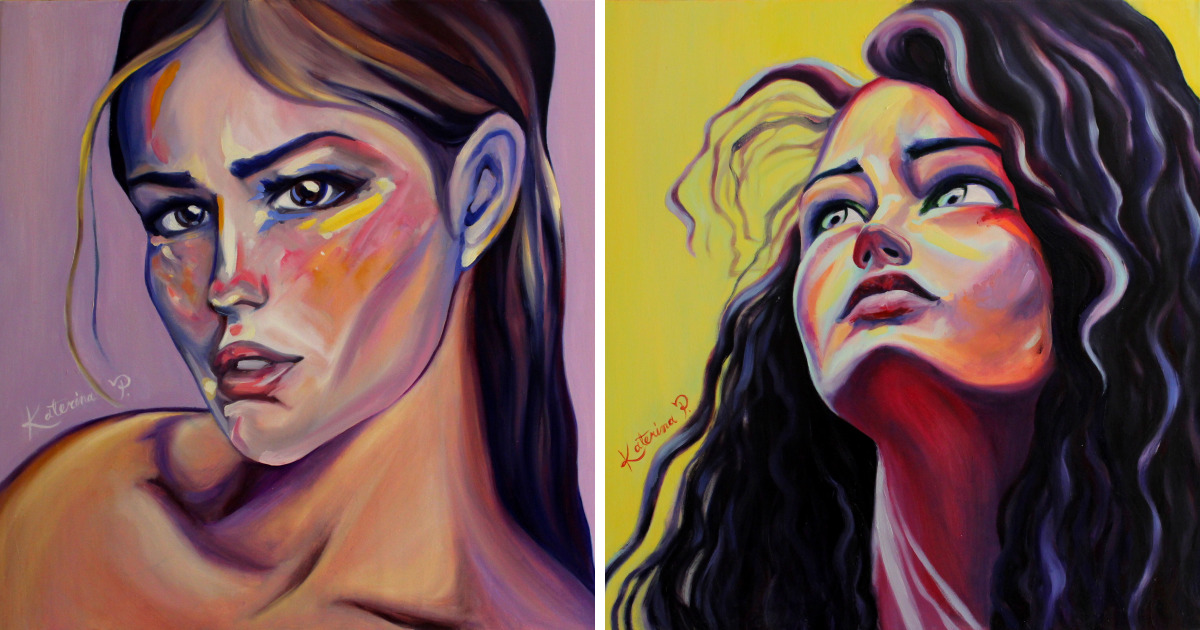
Some portraits politely sit on a wall. Others clear their throat, make eye contact, and ask what exactly you are doing with your one wild and emotionally complicated life. The bold portraits of Canadian artist Katerina Pravda belong firmly in the second category. They are colorful, expressive, elegant, and just a little fearlessthe visual equivalent of someone walking into a gray room wearing a red coat and refusing to apologize for it.
Pravda’s portrait work is not simply about painting faces. It is about painting moods, thresholds, memory, fragility, courage, and the strange inner weather that makes human beings so endlessly fascinating. Her use of vibrant color, expressive brushwork, and psychologically charged composition turns portraiture into something more than likeness. It becomes a mirror with better lighting.
The series that first drew wide online attention was described as a collection of oil portrait paintings shaped by introspection, emotional stages, and a desire to bring color into darker seasons. That makes sense. In Canada, where winter can sometimes feel like the sun has gone on a suspiciously long business trip, bold color becomes more than decoration. It becomes a survival strategy with excellent taste.
Who Is Katerina Pravda?
Katerina Pravda is a Canadian contemporary visual artist known for bold color, expressive line, and emotionally sensitive subjects. Based in Ontario, she has built a recognizable body of work that moves between people, animals, environment, imagination, and surrealism. Her portraits often feel as if they are suspended between the real and the symbolic: familiar enough to feel human, mysterious enough to keep us looking.
Pravda earned a Bachelor of Fine Arts with distinction from Mount Allison University in Canada and also studied abroad at the University of Newcastle in Australia. That international experience appears to have encouraged a freer, bolder visual language in her art. Her work has been associated with expressive brushwork, sophisticated movement, and a concern for the deep interconnection between people, animals, and the natural world.
While many artists use portraiture to preserve appearance, Pravda uses it to investigate presence. Her portraits do not merely ask, “What does this person look like?” They ask, “What does it feel like to be awake inside a human life?” That is a much bigger questionand frankly, one that deserves more wall space.
Why These Bold Portraits Feel So Alive
The first thing most viewers notice is color. Pravda’s portraits can glow with blues, pinks, violets, yellows, reds, and unexpected tonal shifts that refuse to behave like ordinary skin tones. Instead of using color as a realistic surface, she uses it as emotional architecture. A cheek may become a field of warmth. A shadow may turn electric. A quiet gaze may suddenly feel full of storm clouds, neon signs, and private thoughts.
This is where the work becomes powerful. Color in portraiture can do what plain description cannot. It can suggest tension, tenderness, hope, exhaustion, defiance, or transformation before the viewer has time to name those feelings. Research into color psychology has long explored how color perception is connected with emotional and aesthetic response, while also noting that context, culture, and personal experience shape how people interpret color. In art, that flexibility is not a weakness. It is the fun part.
Pravda’s portraits understand that human beings are not beige, even when our office walls try very hard to convince us otherwise. We are layered. We contradict ourselves before breakfast. We can be brave and uncertain, joyful and tired, confident and quietly falling apart in the cereal aisle. Her bold portraits allow room for that complexity.
Portraiture as a Window Into the Human Condition
Portraiture has always been more than a record of faces. Museums and art historians often describe portraits as tools for exploring identity, status, memory, psychology, biography, and human experience. A portrait can reveal how a subject wants to be seen, how an artist interprets them, and how a society understands personhood at a particular moment in time.
That is why Pravda’s work feels so relevant. In an age overflowing with profile pictures, filters, avatars, and carefully selected online versions of ourselves, a painted portrait can slow the whole performance down. It does not swipe away. It does not refresh. It stays. It asks us to look, and then to look again.
Her portraits are especially compelling because they seem less interested in perfection than in emotional truth. The faces are bold, but not loud for the sake of being loud. The eyes often carry the weight of the image. The colors create atmosphere. The brushwork gives the figures motion and vulnerability. The result is portraiture that feels intimate without being sentimental.
The Face as a Landscape
One useful way to understand these paintings is to think of the face as a landscape. Instead of mountains and rivers, we get cheekbones, brows, lips, and eyes. Instead of weather, we get emotion. A painted face can hold traces of memory, fear, humor, longing, and resilience. In Pravda’s work, the face becomes a terrain where inner life rises to the surface.
This approach connects her portraits with a long tradition of artists who used the human figure to explore more than anatomy. Modern portraiture, expressionism, surrealism, and contemporary figurative painting have all challenged the idea that a portrait must behave like a passport photo. Thank goodness. Passport photos already have enough emotional damage to answer for.
The Power of Bold Color in Emotional Storytelling
Bold color can make a portrait unforgettable, but it must be used with intention. Too much random color and a painting can become visual confetti. Pravda avoids that trap by using color to build feeling. Her hues are expressive, but they also appear carefully balanced. They guide attention, shape mood, and create movement across the canvas.
A vivid red or orange may suggest heat, urgency, or inner force. Blue may create coolness, distance, melancholy, or calm. Violet can feel spiritual, strange, or dreamlike. Green can hint at growth, tension, nature, or renewal. None of these meanings are fixed like traffic signs. Instead, they work more like emotional invitations. The viewer brings their own experiences into the painting, and the painting returns something slightly different each time.
This is one reason Pravda’s portraits inspire people. They do not hand the viewer a single answer. They create a space where interpretation is welcome. A viewer may see confidence in one portrait, while another sees grief. Someone may see transformation; someone else may see survival. The painting does not panic. It can hold all of it.
Canadian Winter, Inner Weather, and the Need for Light
The origin story behind Pravda’s colorful portrait series adds another layer of meaning. The artist has connected her drive toward bright, vibrant work with the darker months in Canada, when daylight becomes limited and the emotional atmosphere can feel heavier. In that context, color becomes both aesthetic choice and emotional response.
This matters because art often grows out of lived conditions. Climate, place, season, and personal transformation can all shape an artist’s visual language. For Pravda, the movement toward color reads like an act of resistance against darknessnot a denial of it, but a refusal to let it have the final word.
That is deeply human. Most people know what it feels like to need brightness, whether literal or emotional. We reach for music, humor, friendship, movement, prayer, sunlight, a good meal, a ridiculous meme, or an artwork that makes the room feel less like a waiting area. Pravda’s portraits sit comfortably in that category: art that brightens without pretending life is always easy.
How the Portraits Balance Beauty and Vulnerability
One of the strongest qualities of Pravda’s portraiture is the balance between elegance and emotional exposure. The paintings are beautiful, but not shallow. They are polished, but not stiff. They feel stylish without becoming decorative in the forgettable throw-pillow sense of the word.
The figures often seem caught in moments of reflection. Their expressions may be calm, but the colors around and within them suggest movement beneath the surface. This is a smart artistic move because human emotion rarely arrives wearing a name tag. Sometimes sadness looks quiet. Sometimes courage looks still. Sometimes joy is mixed with fatigue. Sometimes the most dramatic thing happening in a room is a person trying not to show what they feel.
Pravda’s portraits honor that subtlety. They do not reduce the human condition to one mood. Instead, they show how a person can contain many emotional states at once. That complexity is what gives the work staying power.
Why Viewers Connect With This Kind of Art
People respond to portraits because people are trained, almost from birth, to read faces. We look for expression, mood, trust, danger, kindness, distance, and recognition. A portrait activates that instinct, but art complicates it in a beautiful way. The painted face is not a person standing in front of us, yet we still respond as if some kind of encounter is taking place.
That encounter can be surprisingly personal. A bold portrait may remind someone of a private season of change. A certain color combination may bring back a memory. A gaze may feel familiar even when the subject is unknown. This is how portraiture becomes universal without becoming generic. The specific image opens a door into shared experience.
Pravda’s work is especially effective because it combines visual impact with emotional openness. It does not require viewers to know advanced art theory before feeling something. You do not need a museum degree, a black turtleneck, or the ability to say “liminality” without blinking. You only need eyes, attention, and a willingness to meet the image halfway.
The Human Condition in Color, Line, and Gaze
The phrase “human condition” can sound grand, like something carved into a university building. But in art, it often comes down to very ordinary questions: Who are we when no one is performing? How do we carry pain? How do we remain tender? What do we hide? What do we reveal by accident? How do we keep becoming ourselves?
Pravda’s portraits approach those questions through color, line, and gaze. Her expressive brushwork suggests that identity is not fixed. It moves. It changes with time, love, loss, environment, and self-understanding. Her color choices suggest that emotion is not invisible; it has temperature, pressure, rhythm, and light.
This is why the paintings feel inspiring rather than merely impressive. They remind us that human complexity is not a flaw. It is the material. The mess, the mystery, the hope, the contradictionsthese are not interruptions to beauty. They are where beauty begins doing its real job.
Art, Reflection, and Emotional Well-Being
Looking at art is not the same as receiving therapy, and a painting should not be asked to do the entire job of a support system. Still, creative expression and engagement with the arts have been widely discussed in relation to stress relief, communication, reflection, and well-being. Visual art can offer a nonverbal way to process emotion, especially when words feel clumsy or too small.
That helps explain why emotionally rich portraits can feel restorative. They give shape to feelings that might otherwise stay foggy. They also remind viewers that inner complexity is shared. When a portrait seems to hold vulnerability, strength, confusion, and grace all at once, it can make the viewer feel less alone in their own contradictions.
Pravda’s paintings do not shout motivational slogans. They do something better. They create a visual space where joy and introspection can coexist. That is far more honestand much less likely to end up printed on a mug next to a cartoon cat.
What Artists and Art Lovers Can Learn From Pravda’s Portraits
For artists, Pravda’s work offers a useful lesson: style becomes memorable when it serves meaning. Bold color alone is not enough. Expressive brushwork alone is not enough. A portrait becomes powerful when every visual choice points toward a deeper emotional experience.
For collectors and art lovers, her work is a reminder to choose art that does more than match the sofa. Matching the sofa is fine; sofas have feelings too, probably. But the best artwork also changes the emotional temperature of a room. It creates conversation. It rewards repeated viewing. It gives people something to return to.
For everyday viewers, these portraits offer permission to feel. That may sound simple, but it is not. Many people move through daily life editing themselves down to a socially acceptable summary. Art can reverse that process. A bold portrait can say, without words: be more than your surface. Be vivid. Be complicated. Be here.
Experience-Based Reflections: What These Portraits Can Teach Us About Seeing People
Standing in front of a bold portrait is a different experience from scrolling past an image online. Online, the eye is impatient. It hunts, judges, clicks, and moves on. In front of a portrait, especially one built with rich color and emotional force, time behaves differently. The viewer begins by noticing the obviousthe face, the palette, the eyesbut then smaller details start to speak. A brushstroke near the mouth. A cool shadow against warm skin. A gaze that seems direct one moment and distant the next.
This kind of looking teaches patience. It also teaches humility. We often assume we understand people quickly. We read a face, a tone, a style, a social media post, and decide we know the story. Portraiture pushes back against that habit. It reminds us that every person contains hidden rooms. Some are bright. Some are locked. Some are still under renovation, emotionally speaking, with paint cans everywhere and no one able to find the ladder.
Pravda’s portraits encourage a more generous way of seeing. Their boldness does not flatten the subject; it opens the subject up. The colors suggest that what is inside a person may be brighter, stranger, softer, or more intense than the outside world usually allows. That idea has practical value beyond art. It can change how we look at friends, strangers, family members, and even ourselves.
Many people have had the experience of feeling unseen while appearing perfectly fine. A person can answer emails, buy groceries, laugh at the right time, and still be carrying a private emotional weather system. That is why expressive portraiture matters. It gives visual dignity to inner life. It says that what happens inside a person is worthy of attention, even when it cannot be neatly explained.
These portraits also remind us that inspiration does not always arrive as cheerfulness. Sometimes it arrives as recognition. A painting can inspire by making us feel braver, but it can also inspire by making us feel understood. There is comfort in seeing complexity treated as beautiful. There is relief in encountering artwork that does not demand simplicity from us.
In a world that often rewards speed, polish, and easy categories, Pravda’s bold portraits invite viewers to slow down and notice emotional nuance. They suggest that color can be a language, that faces can be landscapes, and that vulnerability can have tremendous visual power. Most of all, they remind us that the human condition is not some distant philosophical concept. It is right here: in the eyes, in the posture, in the colors we choose, in the stories we carry, and in the light we keep reaching for even when the season turns dark.
Conclusion
Katerina Pravda’s breathtakingly bold portraits stand out because they combine beauty with psychological depth. They are vivid without being shallow, emotional without being melodramatic, and inspiring without slipping into cliché. Through expressive color, thoughtful composition, and a deep interest in human and environmental connection, Pravda turns portraiture into a conversation about identity, feeling, and transformation.
Her work reminds us that the face is never just a face. It is a map of experience, a performance of identity, a shield, a window, and sometimes a quiet confession. These portraits look into the human condition because they understand that being human is not about having one simple story. It is about carrying many colors at once.