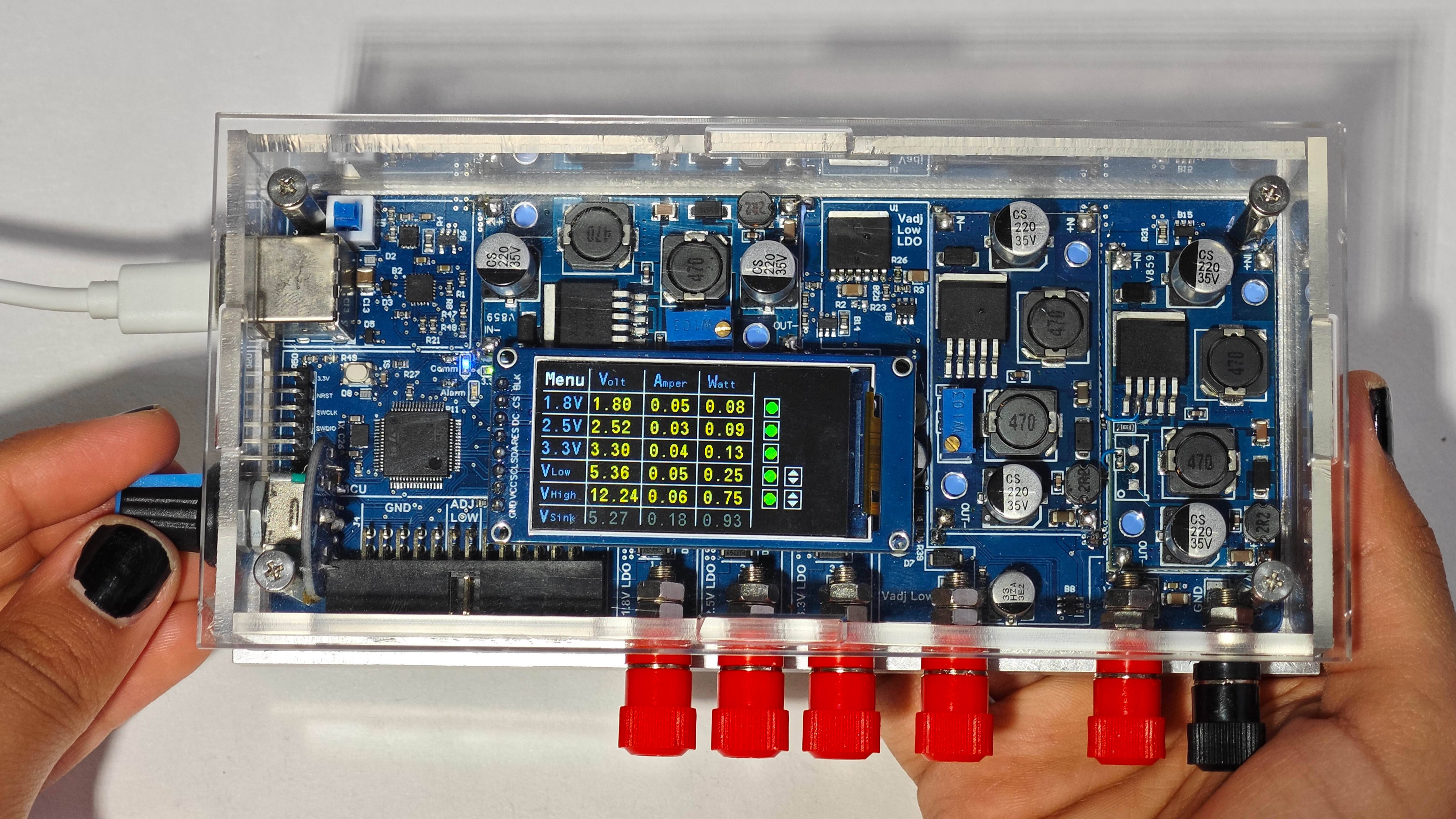
There is a certain comedy to modern electronics work: we can fit a powerful microcontroller on a board smaller than a postage stamp, but the bench power supply still wants half the desk, its own fan club, and enough cable drama to qualify as performance art. That is exactly why BenchVolt PD is interesting. It takes the familiar convenience of USB Power Delivery and pushes it toward a more serious laboratory role: powering prototypes, development boards, sensors, analog circuits, and small test setups from a compact multi-channel supply.
BenchVolt PD is not trying to replace every full-size programmable DC power supply in a professional lab. A calibrated, high-end instrument still has its throne. But for makers, embedded developers, field technicians, robotics hobbyists, students, and engineers who want a flexible power source without dragging a metal brick across the room, BenchVolt PD lands in a very useful middle ground. It is compact, open-source, USB-C powered, and designed around the kind of mixed-voltage projects that show up on real benches every day.
What Is BenchVolt PD?
BenchVolt PD is a five-channel, open-source USB-C PD laboratory power supply designed to turn a USB Type-C charger or compatible power bank into a portable bench-style power system. Instead of using USB-C simply to charge a phone or laptop, the device negotiates power from a USB PD source and then distributes regulated outputs through multiple channels.
The design offers three fixed rails commonly used in digital electronics: 1.8 V, 2.5 V, and 3.3 V. It also includes two adjustable outputs: one in the lower range, useful for small logic and sensor work, and another that can reach higher voltages for broader prototyping needs. Each output is designed with current limiting in mind, which is one of the biggest differences between “just powering something” and powering it responsibly.
In simpler language, BenchVolt PD aims to do what many makers secretly wish their random drawer of chargers could do: provide several clean, controlled voltages at once, with visibility and protection. It is the difference between “I hope this board survives” and “I know what voltage and current this board is seeing.”
Why USB Power Delivery Changes the Game
USB Power Delivery, often shortened to USB PD, has grown far beyond the old days of 5 V phone charging. Modern USB-C PD chargers can negotiate different voltage and current levels, allowing one charger to power phones, tablets, laptops, monitors, and other devices. With USB PD Revision 3.1, the specification expanded to support even higher power levels, but BenchVolt PD focuses on the very common and widely available 100 W class.
That matters because 100 W USB-C chargers are everywhere now. Many people already own one for a laptop. Instead of buying a dedicated supply for every portable experiment, BenchVolt PD uses that existing power ecosystem as the input stage. The clever part is not that USB-C provides energy; the clever part is converting that energy into multiple bench-friendly outputs with control, monitoring, and safety features.
USB-C Convenience, Bench Supply Behavior
A normal USB-C charger is designed to negotiate with a device and provide a suitable power profile. A benchtop supply is designed to let the user choose voltage, set current limits, observe behavior, and protect the device under test. BenchVolt PD blends those two worlds. It uses USB PD as the upstream power source, then behaves more like a compact lab supply on the downstream side.
This is especially useful for developers working with boards that require more than one voltage rail. A microcontroller may need 3.3 V, a sensor may need 1.8 V, an analog front end may prefer a cleaner regulated rail, and a motor driver or small module may need a higher adjustable voltage. BenchVolt PD turns that messy voltage buffet into something more organized.
Five Channels: The Real Practical Advantage
The headline number is 100 W, but the more important feature may be the five-channel layout. Many beginner power solutions provide one adjustable output. That is fine until a project needs multiple rails. Then the bench becomes a festival of USB adapters, jumper wires, boost modules, buck converters, and labels written in panic.
BenchVolt PD’s fixed channels cover common low-voltage electronics. The 3.3 V rail is useful for microcontrollers, development boards, sensors, displays, and logic circuits. The 1.8 V and 2.5 V rails are handy for more modern ICs, low-power devices, memory, and digital interfaces that do not want the old-school 5 V treatment. The adjustable channels add flexibility for testing modules, driving small loads, experimenting with analog circuits, or slowly bringing up a prototype.
Fixed Rails for Everyday Electronics
Fixed rails are underrated. When a project needs 3.3 V, it does not always need a dramatic knob-turning ceremony. It just needs 3.3 V that is ready, stable, and protected. Fixed outputs reduce setup time and mistakes, especially when powering multiple boards. They also make BenchVolt PD feel more like a practical work companion than a novelty gadget.
Adjustable Outputs for Real Testing
Adjustable outputs are where the device becomes more laboratory-like. Being able to dial in a voltage is useful for checking dropout behavior, testing sensor tolerances, validating regulator input ranges, or slowly increasing supply voltage during first power-up. When paired with current limiting, adjustable voltage becomes a safer way to explore unknown circuits.
For example, imagine a freshly assembled PCB. Instead of slamming it instantly with the expected final voltage, you can start low, set a conservative current limit, and watch the current draw. If the board pulls too much current too quickly, the supply can limit the damage. That small safety net can save components, time, and occasionally your pride.
Current Limiting: The Feature That Saves Projects
Current limiting is one of the most important features of any serious bench power supply. In constant voltage mode, the supply tries to hold the selected voltage while the load draws the current it needs. If the load tries to draw more than the set current limit, the supply can transition into constant current behavior, reducing voltage as needed to keep current under control.
This is not just a technical detail; it is a survival mechanism. A short circuit, reversed component, solder bridge, damaged IC, or miswired connector can cause a circuit to draw far more current than expected. Without a current limit, the result may be hot components, damaged traces, or that unmistakable smell of electronics learning a hard lesson.
BenchVolt PD’s current-limited channels make it much more useful than a basic charger breakout board. A charger gives power. A bench-style supply gives power with boundaries. For electronics work, boundaries are good. They keep small mistakes from becoming expensive confetti.
Built-In Monitoring and Control
Another key part of BenchVolt PD’s appeal is monitoring. A useful power supply does not just output voltage; it tells you what is happening. Voltage, current, thermal behavior, USB PD status, and channel conditions all matter when debugging a circuit.
Real-time readouts help answer basic but important questions. Is the board actually drawing current? Did the current jump when firmware enabled a radio module? Is the load behaving differently at 3.0 V compared with 3.3 V? Did a motor startup cause a noticeable dip? These observations are often the difference between guessing and diagnosing.
Why Readback Matters
A multimeter is still essential, but built-in readback makes daily testing faster. When the power supply itself displays output behavior, you can quickly spot abnormal current draw or confirm that a rail is active. For embedded work, this is especially useful during sleep-mode testing, peripheral bring-up, and firmware experiments where current consumption changes with code behavior.
Waveform-Capable Outputs: A Bonus for Experimenters
BenchVolt PD also includes waveform-capable behavior on adjustable outputs, which makes it more interesting than a typical compact supply. Waveform generation can be useful for testing response to changing supply conditions, simulating voltage ramps, checking simple analog behavior, or creating repeatable power sequences.
This does not mean it replaces a dedicated function generator for every job. A real lab function generator still offers broader bandwidth, triggering, impedance options, modulation, and precision features. But for slow voltage ramps, simple patterns, and power-related experiments, waveform-capable supply outputs can be surprisingly handy.
Open Source Matters More Than It Sounds
The open-source nature of BenchVolt PD is a major advantage for its target audience. Makers and engineers often prefer tools they can inspect, modify, repair, and learn from. An open design can become both a practical instrument and an educational reference.
For students, it offers a window into USB PD negotiation, DC-DC conversion, LDO regulation, microcontroller control, monitoring, firmware design, and user-interface decisions. For advanced users, open hardware and firmware create room for customization. Maybe someone wants different connectors, altered firmware behavior, a custom enclosure, calibration experiments, or integration with a Python workflow. Open-source tools invite that kind of curiosity.
A Tool You Can Study, Not Just Use
Many commercial instruments are excellent, but they are black boxes. BenchVolt PD is closer to a teaching instrument. Users can study how the system sequences power, how it monitors temperature and current, how the USB PD sink controller participates in power negotiation, and how multiple regulators work together. That makes it valuable even beyond its daily use on a bench.
Where BenchVolt PD Fits in a Modern Electronics Bench
BenchVolt PD is best understood as a compact, portable, multi-output power tool for low-to-moderate-power electronics. It is not the ideal choice for every test case. If you need ultra-high precision calibration, very low noise characterization, high voltage isolation, four-quadrant sourcing and sinking, or certified production testing, a professional bench supply or source measure unit is still the right instrument.
But many daily tasks do not need a $2,000 lab instrument. They need a safe way to power a microcontroller board, a sensor module, a display, a small analog circuit, or a prototype in the field. BenchVolt PD’s strength is convenience with enough control to be useful.
Good Use Cases
- Powering multiple development boards at the same time
- Testing 1.8 V, 2.5 V, and 3.3 V logic circuits
- Bringing up new PCBs with conservative current limits
- Running portable experiments from a USB-C charger or power bank
- Teaching power supply concepts in a classroom or maker lab
- Checking current draw during firmware development
- Creating slow voltage ramps or basic supply waveforms
Where a Traditional Bench Supply Still Wins
A traditional programmable DC power supply still wins when you need certified accuracy, excellent load regulation under demanding conditions, remote sensing, high current at one rail, deeper automation, traceable calibration, or long-term production reliability. BenchVolt PD should be seen as a clever portable addition, not a magic wand that makes all lab gear obsolete.
USB PD Power Budgeting: Read the Fine Print Before the Smoke
Because BenchVolt PD depends on the attached USB-C power source, the available power depends on the charger and cable. A 100 W charger gives the system more headroom than a 65 W charger. A low-quality cable can also limit performance or create reliability issues. This is not a flaw in BenchVolt PD; it is simply how USB PD systems work.
Users should think in terms of total power budget. If several channels are active at once, the total output cannot exceed what the upstream charger and internal converters can practically provide. Regulation losses also matter. No converter is perfectly efficient, and LDO-regulated outputs trade some efficiency for cleaner rails. The smart approach is to plan power use instead of assuming every channel can run at its maximum rating simultaneously forever.
Precision, Noise, and Real-World Expectations
The word “precision” deserves a careful explanation. In a full metrology lab, precision has strict meanings involving accuracy, resolution, noise, stability, calibration, and traceability. In a maker or development environment, precision often means something more practical: the supply can be set predictably, monitored clearly, and used safely without wild voltage swings.
BenchVolt PD appears to focus on that practical version of precision. Its low-noise fixed rails are well suited for sensitive digital and mixed-signal circuits, while its higher adjustable output gives flexibility for less noise-sensitive loads. For extremely sensitive analog, RF, or measurement circuits, users should still verify ripple and noise with proper instruments. The best rule is simple: trust useful tools, but measure critical results.
Why Makers Are Paying Attention
BenchVolt PD is appealing because it matches how people actually build things today. The modern electronics bench is smaller, more mobile, and more mixed-voltage than ever. A project may involve a USB-C laptop, a dev board, a wireless module, a display, a sensor breakout, a battery charger circuit, and a small actuator. One single-output supply can feel outdated in that environment.
The device also fits the rise of portable labs. Engineers now debug hardware in coworking spaces, classrooms, robotics competitions, field installations, repair benches, and kitchen tables. A compact USB-C powered supply makes sense in that world. It is not just about saving desk space. It is about making serious electronics work easier to start.
Specific Example: Bringing Up a Sensor Board
Suppose you have a new sensor board with a 3.3 V microcontroller, a 1.8 V sensor, and a small analog measurement section. With a typical single-channel supply, you might need extra regulators or multiple modules to power everything. With BenchVolt PD, you can assign fixed rails to the digital and sensor sections, then use an adjustable output for testing a related circuit block.
During first power-up, you could set current limits conservatively and monitor draw from each rail. If the 1.8 V rail suddenly pulls too much current, you know where to start looking. That beats the classic debugging method of staring at the board and whispering, “Please do not be the BGA.”
Specific Example: Firmware Power Profiling
Firmware developers often need to know how code affects power. A radio module wakes up, a sensor starts sampling, a display backlight turns on, or a motor controller enters standby. BenchVolt PD’s monitoring can help reveal these changes during development.
It will not replace a dedicated power analyzer for ultra-low-current sleep profiling, but it can still provide useful everyday visibility. For many embedded projects, simply seeing that current changed from “reasonable” to “why is this tiny board eating lunch?” is enough to catch a bug early.
Experience Notes: Living With a USB-C Bench Supply Mindset
The most interesting experience with a tool like BenchVolt PD is not just the specification sheet. It is the shift in workflow. Traditional bench supplies encourage a fixed work area. You have the supply, the oscilloscope, the multimeter, the soldering station, and the sacred patch cables that somehow vanish when needed. A USB-C powered multi-channel supply changes that rhythm. You can move a project more easily, test in smaller spaces, and bring enough power control to places where a full bench supply would be annoying.
In practical use, the biggest benefit is speed. When a prototype needs 3.3 V and 1.8 V, you do not want to assemble a tower of regulator boards just to begin testing. You want rails ready now. BenchVolt PD’s fixed outputs make that process feel cleaner. It is the kind of tool that reduces setup friction, and reducing setup friction matters because many hardware bugs are already rude enough without making the power system rude too.
Another experience-related advantage is confidence during first power-up. Anyone who has built a PCB knows that first-power moment. You plug it in, hold your breath, and briefly become a philosopher. Will it work? Will it short? Will the chip get hot? Will the board reveal that you mirrored a connector at 2 a.m.? A current-limited supply makes that moment less dramatic. You can set a safe current ceiling, raise voltage carefully, and watch behavior instead of gambling with components.
The USB-C input also makes the tool feel modern. Many labs and home benches already have several USB-C chargers. A high-quality 100 W charger becomes the upstream energy source, while BenchVolt PD handles distribution and control. This is especially useful for field work. Imagine testing a small sensor node on-site, powering a microcontroller board during installation, or checking a repaired module without unpacking a full bench station. A compact supply and a USB-C adapter are easier to carry than a classic metal supply with a thick AC cord and the personality of a toaster oven.
There are still habits users must develop. Power budgeting becomes important. You cannot ignore the wattage of the charger, the cable rating, conversion losses, or the load on each rail. Good USB-C cables matter. Cheap unknown cables can turn a clean setup into a mystery novel. Users should label outputs, double-check polarity, start with conservative limits, and verify critical rails with a meter when the circuit matters. BenchVolt PD makes power easier, but it does not excuse sloppy wiring.
The best experience may come from using it as a companion to other instruments. Pair it with a multimeter for verification, an oscilloscope for ripple and transient checks, and a logic analyzer for digital debugging. In that role, BenchVolt PD becomes a compact power hub rather than a lonely gadget. It gives projects the rails they need, keeps current in check, and leaves more room on the desk for the actual debugging. That is a small luxury, but in electronics, small luxuries add up quickly.
Final Thoughts: A Small Supply With a Big Idea
BenchVolt PD is exciting because it treats USB-C power as more than a charging convenience. It turns the modern USB PD ecosystem into a foundation for a portable, multi-channel lab supply. With fixed rails, adjustable outputs, current limiting, monitoring, waveform-capable behavior, and an open-source design, it speaks directly to the way makers and engineers work today.
It will not replace every traditional bench supply, and it should not be expected to. Instead, its value is flexibility. It brings controlled power to compact workspaces, classrooms, field kits, hobby benches, and prototype labs. For many users, that is exactly the missing piece: not the biggest supply, not the fanciest supply, but the one that is ready when the project is.
In a world full of USB-C chargers, BenchVolt PD asks a very reasonable question: why should all that portable power stop at charging laptops? For electronics builders, the answer may be sitting right on the bench.