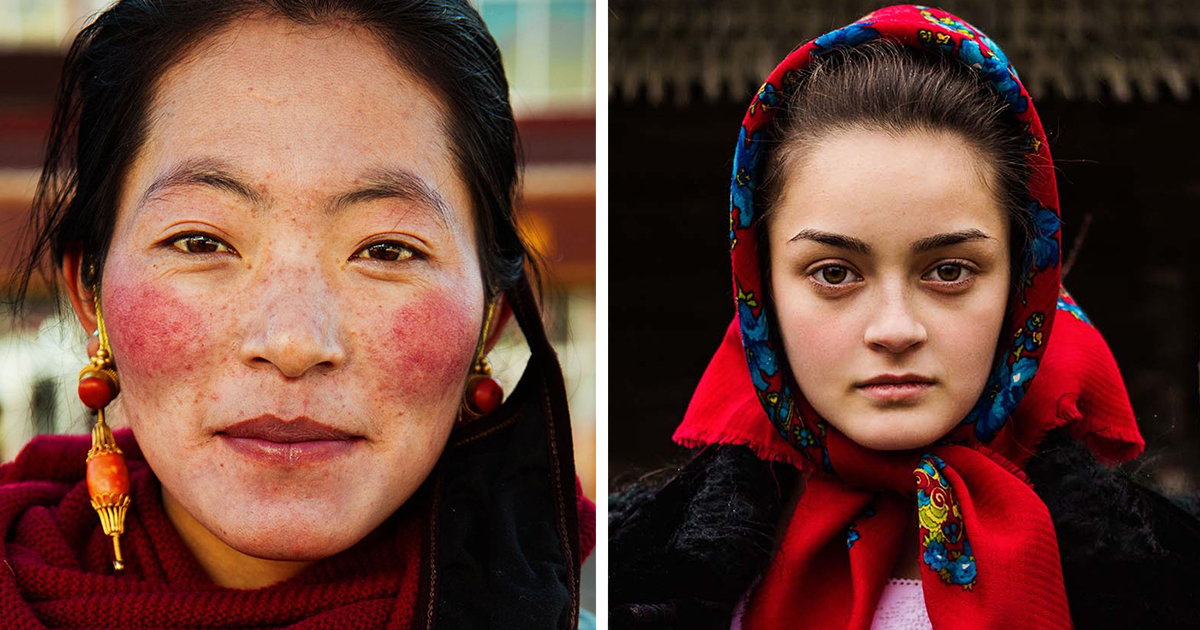
Beauty has a funny way of refusing to stay inside the tiny box people keep trying to build for it. Just when a magazine cover, a runway trend, or a social media filter tries to declare, “This is what beauty looks like,” real life strolls in wearing hiking shoes, a headscarf, a school uniform, a sari, a leather jacket, work clothes, or no makeup at alland politely ruins the whole theory.
That is the heart of the photography project widely known as The Atlas of Beauty, created by Romanian photographer Mihaela Noroc. What began as a personal journey with a backpack, a camera, and a curiosity about people became a global portrait project celebrating women from different countries, cultures, backgrounds, and everyday lives. At one stage, Noroc shared portraits from 37 countries to prove a beautifully simple point: beauty is everywhere, but you have to look at the world with open eyes instead of copy-pasted expectations.
The project resonated because it did not present beauty as a contest, a ranking, or a polished advertisement. It presented beauty as presence. A woman in the Amazon Rainforest. A woman in New York. A woman in Iran. A woman in Ethiopia. A woman in Peru. A woman in Romania. Each portrait carried a different atmosphere, yet the message stayed consistent: authenticity travels better than trends.
The Story Behind a Global Portrait Journey
Mihaela Noroc started The Atlas of Beauty after realizing that the world’s diversity could not be captured through one narrow standard. Instead of photographing celebrities, professional models, or heavily styled subjects, she turned her lens toward everyday women. That choice changed everything.
Her approach was simple but powerful: meet women where they are, photograph them in their natural environments, and let their stories, expressions, clothing, and surroundings speak. This is why the portraits feel warm rather than staged. They are not trying to shout, “Look glamorous!” They whisper something better: “Look human.”
Across the project, viewers encounter women in city streets, markets, homes, villages, deserts, coastlines, temples, forests, and neighborhoods. Some portraits show traditional clothing. Others show modern fashion. Some women look directly into the camera with confidence; others appear quiet, thoughtful, or shy. The magic is not that everyone looks the same. The magic is that nobody has to.
Why 37 Countries Was Only the Beginning
The early wave of portraits from 37 countries helped the project go viral because it arrived at exactly the right cultural moment. Social media had already become a giant beauty machine, feeding people endless images of edited skin, repeated poses, identical makeup trends, and faces shaped by the same digital habits. Then came these portraitsreal, varied, textured, and deeply personal.
Instead of asking women to fit into a fashionable mold, the project asked viewers to expand their own definition of beauty. That is a rare trick. Most beauty content makes the audience compare. The Atlas of Beauty invites the audience to notice.
From those first 37 countries, the project later grew into a much larger body of work, including hundreds of portraits from more than 50 countries. Its expansion proved that the original idea was not a one-time viral headline. It was a long-term visual conversation about identity, culture, dignity, and the small details that make people unforgettable.
Beauty Is Not a Passport StampIt Is a Story
One reason this project remains memorable is that it treats geography as a doorway, not a decoration. A portrait from Havana is not beautiful simply because it is from Cuba. A portrait from the Tibetan Plateau is not powerful only because the location sounds poetic. The deeper value comes from the relationship between person and place.
A woman photographed in her own environment carries layers of context: family history, local traditions, climate, work, language, memory, and personal style. Her surroundings are not props. They are part of the story. A market street, a quiet kitchen, a mountain road, or a colorful neighborhood can reveal as much as clothing or facial expression.
This is where the project becomes more than travel photography. It becomes a reminder that people are not museum objects. They are living individuals with routines, hopes, humor, responsibilities, and private dreams. A good portrait does not steal that complexity; it honors it.
How the Project Challenges Beauty Standards
Beauty standards often pretend to be universal, but they are usually local habits wearing a very expensive coat. What one culture praises, another culture may ignore. What one decade celebrates, the next decade may call outdated. Trends are moody. They change their minds more often than someone standing in front of a closet five minutes before leaving the house.
The Atlas of Beauty challenges that instability by showing women who do not need to chase the same look. Some portraits highlight natural hair textures. Some show traditional garments. Some feature minimal makeup. Others include modern styling, bold colors, or everyday casual clothing. The point is not that one look is better than another. The point is that beauty becomes more meaningful when it is connected to identity rather than imitation.
This message matters because visual culture shapes how people see themselves. When audiences only see one type of face, one age range, one skin tone, one body type, or one fashion standard celebrated again and again, the world starts to feel smaller than it is. Projects like this make the visual world wider. And honestly, the visual world could use the legroom.
The Power of Natural Portrait Photography
Natural portrait photography works best when the photographer understands restraint. Not every image needs dramatic lighting, a wind machine, or a background that looks like it was chosen by a committee of overexcited interior designers. Sometimes the strongest portrait is simple: a face, a place, a moment, and enough trust for the subject to be herself.
Noroc’s portraits often rely on softness rather than spectacle. The women are not transformed into characters; they remain themselves. That gives the images emotional clarity. Viewers are not distracted by heavy production. They can focus on expression, posture, clothing, environment, and the quiet relationship between the subject and the camera.
For photographers, this is an important lesson. A portrait is not successful just because it is sharp, colorful, or technically impressive. A portrait succeeds when it makes the viewer feel that a real person exists beyond the frame. The best images do not flatten someone into an aesthetic. They leave room for curiosity.
Specific Examples That Show the Project’s Range
The project has included portraits from places such as New York, San Francisco, Rio de Janeiro, Havana, Oxford, Myanmar, Iran, Ethiopia, Peru, Romania, Latvia, Georgia, Thailand, Australia, Chile, Ecuador, and beyond. That wide range gives the project its rhythm. It moves from major cities to remote regions, from familiar urban spaces to landscapes many viewers may never visit.
A portrait in New York may suggest speed, individuality, and multicultural energy. A portrait from a rural region may carry a slower visual pace, shaped by land, tradition, and community. A woman photographed near a temple, in a rainforest, beside the sea, or along a city street brings a different kind of atmosphere to the frame.
What connects these images is not sameness. It is dignity. The portraits say: here is a person worth seeing carefully. That careful seeing is the project’s greatest strength.
Why Viewers Responded So Strongly
The viral success of the project was not just about beautiful photos. The internet has plenty of those. You can barely open a browser without tripping over a sunset, a latte, or someone’s suspiciously perfect vacation breakfast.
What made this project different was emotional contrast. In a media environment filled with polished sameness, these portraits felt refreshing. They celebrated individuality without turning it into a slogan. They showed cultural difference without treating it as costume. They reminded viewers that beauty is not rare; attention is rare.
People responded because the images were generous. They did not demand that viewers choose the “most beautiful” woman. They encouraged viewers to recognize beauty in many forms. That is a healthier and more interesting way to look at the world.
Photography, Respect, and Cultural Sensitivity
Any global portrait project must handle cultural representation carefully. Photographing people across countries and communities is not just an artistic act; it is also an ethical responsibility. The camera can celebrate, but it can also simplify if used carelessly.
The strongest images in projects like this are those that preserve individuality. A woman should not become a symbol of an entire country, continent, or culture. No single portrait can represent millions of people. Instead, each portrait should be understood as one encounter, one person, one story, and one moment.
That distinction is important. The beauty of the project is not that it “explains” every culture. It does not, and no photo series can. Its value lies in opening a window and encouraging viewers to look with humility. The best response is not, “Now I understand this whole country.” The better response is, “I want to learn more.”
What This Project Teaches About Authenticity
Authenticity is one of those words that gets thrown around so much it sometimes needs a nap. But in this context, it matters. The project suggests that authenticity is not about rejecting style, fashion, or self-expression. It is about not erasing yourself to become acceptable to someone else’s standard.
A person can be authentic in traditional clothing or jeans, with makeup or without it, in a busy city or a quiet village. Authenticity is not a costume. It is alignment. It happens when the outer image still leaves room for the inner person.
That is why the portraits feel emotionally steady. They are not chasing shock value. They are not trying to make difference look exotic. They are simply showing that the human face, when treated with respect, can carry a world of meaning.
The SEO Meaning Behind the Title
The title “I Photographed Women From 37 Countries To Show That Beauty Is Everywhere” works because it is direct, visual, and emotionally clear. It promises a journey, a message, and a gallery of human diversity. For search engines, it naturally connects with keywords such as global beauty, women portraits, portrait photography, beauty standards, cultural diversity, and women around the world.
For readers, the title works because it creates curiosity. Which countries? What kinds of portraits? What does beauty look like across cultures? The headline invites the click, but the idea behind it earns the attention.
That balance is exactly what strong online content needs. A good article should not trick readers into arriving. It should welcome them, deliver substance, and give them a reason to stay longer than five seconds. Preferably without pop-ups chasing them like digital mosquitoes.
Experiences Related to Photographing Women Around the World
When thinking about a project like this from a photographer’s perspective, the first experience that stands out is learning how to approach people with respect. A portrait begins before the camera is raised. It begins with body language, tone, patience, and the ability to accept “no” gracefully. In street and travel portraiture, the subject is not there to decorate the photographer’s portfolio. She is a person deciding whether to share a few seconds of trust.
Another important experience is realizing how much beauty lives in ordinary moments. Many photographers begin by looking for dramatic scenes: golden light, perfect backgrounds, cinematic streets, and colors that make the camera feel like it deserves applause. But after enough time observing people, the quieter images often become more powerful. A woman waiting for a bus, arranging flowers, walking through a market, laughing with a friend, or standing in the doorway of her home may create a portrait that feels more honest than anything staged.
Travel also teaches photographers to slow down. It is tempting to arrive in a new country with a checklist: famous landmark, local food, scenic street, portrait, next location. That approach may produce images, but it rarely produces understanding. The better experience is to spend time noticing patterns. How do people greet each other? What colors appear in daily clothing? How does the light fall in the morning? What do people seem proud of? What makes them laugh? The answers help a photographer create portraits that feel connected to place rather than dropped onto a background.
Language barriers can be challenging, but they can also make the process more human. A smile, a gesture toward the camera, a respectful distance, and a willingness to show the photo afterward can build a small bridge. Of course, permission matters. Consent is not a tiny technical detail hiding in the camera bag. It is the foundation of ethical portraiture.
One of the most meaningful experiences in this kind of work is discovering that people often want to be seen beyond stereotypes. A woman from a remote region may also love modern music. A woman in a huge city may carry old family traditions. A student may be practical and poetic at the same time. A mother may be exhausted, proud, funny, and elegant all in one frame. Real people are beautifully inconvenient to clichés.
Photographing women across cultures also changes the photographer. It makes narrow definitions feel dull. It becomes harder to believe in one standard of beauty after seeing so many forms of confidence, tenderness, resilience, humor, intelligence, and self-possession. The camera becomes less like a tool for collecting images and more like a reminder to pay attention.
That is the lasting experience connected to the idea behind “I Photographed Women From 37 Countries To Show That Beauty Is Everywhere.” The work is not only about proving beauty exists in many places. It is about training the eye to recognize it without demanding that it change first.
Conclusion: Beauty Is Everywhere, But We Must Learn to See It
The Atlas of Beauty continues to matter because it offers an antidote to visual sameness. It reminds us that beauty is not owned by one country, one trend, one age, one skin tone, one outfit, or one type of face. Beauty can be cultural, personal, quiet, bold, traditional, modern, familiar, surprising, and deeply human.
The portraits from 37 countries were never just about travel. They were about attention. They asked viewers to look at women around the world with curiosity instead of comparison. They invited people to see difference not as distance, but as richness.
In a world that often tries to package beauty into a narrow commercial formula, this project says something far more generous: beauty is already everywhere. No passport requiredthough a camera, an open mind, and decent walking shoes certainly help.
Note: This article is an original synthesis based on publicly reported information about Mihaela Noroc’s global photography project, The Atlas of Beauty. It is written for web publication in a natural editorial style and does not reproduce any single source.