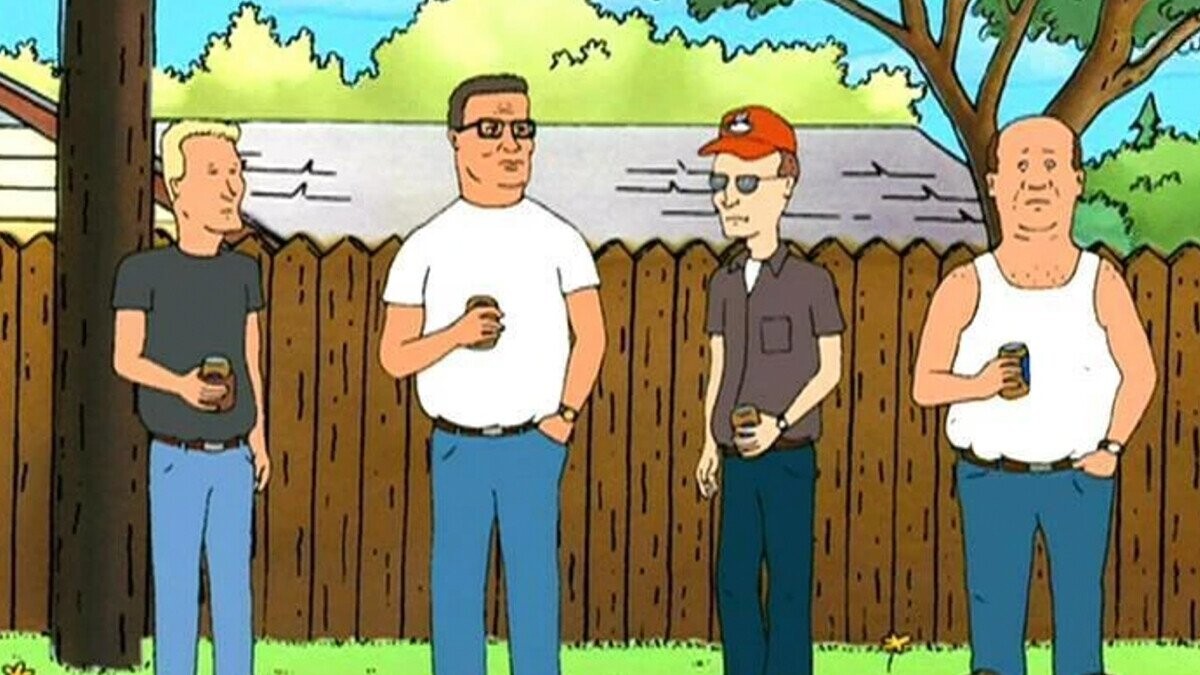
For years, King of the Hill fans survived on reruns, memes, propane jokes, and the faint hope that Hank Hill would one day return to stare suspiciously at a smart refrigerator. Then the reboot became real. Hulu brought the Hill family back, creators Mike Judge and Greg Daniels returned, and suddenly the quiet Texas cul-de-sac of Arlen felt less like nostalgia and more like unfinished business.
Before the revival officially arrived, though, fans appeared to get an accidental peek behind the curtain. A set of episode titles connected to the new King of the Hill season surfaced through Writers Guild of America-related records, and the internet did what the internet does best: leaned forward, squinted dramatically, and began decoding every pun like it was a government file Dale Gribble had been waiting his entire life to open.
The reported titles were not just random labels. They offered hints about Hank, Peggy, Bobby, Kahn, beer, sports, money, aging, and the awkward process of dragging a deeply grounded animated sitcom into modern life without turning it into a theme-park version of itself. And honestly? That is exactly the kind of leak that can make a fandom act like someone found the secret recipe for Alamo Beer.
The Reported First 10 Episode Titles
The first batch of titles reportedly connected to the King of the Hill reboot included ten episodes. At the time, they appeared to map closely to what would become the revival’s opening season, later known as Season 14. The titles were:
- Return of the King
- The Beer Story
- Chore Money, Chore Problems
- Any Given Hill-Day
- New Ref in Town
- Peggy’s Fadeout
- Bobby Gets Grilled
- No Hank Left Behind
- A Sounder Investment
- Kahn-scious Uncoupling
That list reads like classic King of the Hill: plainspoken on the surface, sneaky underneath, and just punny enough to make you groan into a lawn chair. The show has always loved titles that sound simple until you realize they are quietly doing character work. Hank does not need dragons, multiverses, or exploding planets. Give the man a broken rating system, a beer contest, a charcoal grill, or a soccer field, and suddenly civilization itself is at stake.
Why the Leak Got Fans So Excited
Episode-title leaks are usually tiny scraps of information. But with a show like King of the Hill, titles can be surprisingly revealing. This is not a series built around giant cliffhangers. Its comedy lives in small discomforts: a handshake that feels wrong, a neighbor who overexplains conspiracies, a father who cannot understand why his son insists on being interesting in public.
That is why titles like “The Beer Story” and “Bobby Gets Grilled” immediately felt meaningful. Beer and grilling are not just props in this universe; they are social systems. Hank’s grill is practically a family altar, except with cleaner tongs. Beer in the alley is where friendship happens, emotional repression is quietly maintained, and Bill Dauterive says something devastatingly sad before everyone pretends not to hear it.
The leak also reassured fans that the reboot was not trying to disguise itself as a completely different show. The titles suggested a continuation rather than a hard reset. There were jokes about modern life, sure, but the names still sounded like they belonged to Arlen. That matters. A revival can survive aging its characters. It rarely survives forgetting why people liked them in the first place.
What “Return of the King” Suggests About the Revival
“Return of the King” is an obvious, confident opener. It works as a joke, a wink, and a mission statement. Hank Hill is not royalty, unless we are ranking kings of lawn care, propane loyalty, and saying “I tell you what” with moral authority. But after more than a decade away from new episodes, the title makes the comeback feel ceremonial.
More importantly, the title sets up the emotional premise of the revival: Hank and Peggy returning to Arlen after years away. The best version of a King of the Hill reboot was never going to be about pretending time stopped. The old show worked because it understood daily life. So the new show had to understand that daily life had changed. Smartphones, app ratings, gig work, culture-war confusion, craft food trends, and retirement anxiety all become natural fuel for Hank’s particular brand of confusion.
The trick is that Hank has always been out of step. That is not new. The world being weird to Hank Hill is basically the show’s renewable energy source. The reboot simply updates the weirdness. Instead of being baffled by boy bands or yoga, Hank now has to process apps, new social codes, and a grown Bobby who has become a serious chef. Somewhere, a charcoal briquette trembles.
Bobby Hill as the Revival’s Secret Weapon
One of the biggest creative opportunities in the reboot is adult Bobby. In the original series, Bobby was the kid Hank loved deeply but could not always understand. He was theatrical, sweet, strange, funny, food-obsessed, and completely immune to the idea that masculinity had to look like a hardware-store aisle.
By aging Bobby into adulthood, the revival gives the series a fresh engine. He is no longer just the boy who “ain’t right.” He is a young man who may, in fact, be extremely right for the world he lives in. His career as a chef fits him beautifully. It honors his old love of performance, taste, confidence, and emotional openness. It also gives Hank a new kind of challenge: What happens when your son’s weirdness becomes competence?
“Bobby Gets Grilled” is the title that best captures this dynamic. It promises food, conflict, and probably Hank looking at a cooking method like it insulted Texas. But underneath the joke is a deeper father-son story. Bobby’s adulthood forces Hank to stop parenting a child and start relating to a man. For a character as emotionally buttoned-up as Hank, that is harder than assembling patio furniture without the instructions.
The Beer, the Chores, and the Modern Economy
“The Beer Story” sounds simple, almost suspiciously simple. But beer in King of the Hill has always been a social ritual. The alley beers are less about drinking and more about belonging. They are how Hank, Dale, Bill, and Boomhauer maintain friendship without accidentally saying anything too vulnerable.
In a modern context, beer also opens the door to craft brewing, non-alcoholic trends, hobbyist culture, and the comedy of Hank facing a world where beer can be described with tasting notes longer than a church bulletin. Hank likes quality, but he does not like nonsense. A beer competition is exactly the sort of setting where he could become both sincere and unbearable, which is a sacred sitcom combination.
“Chore Money, Chore Problems” points in another modern direction: work, apps, ratings, and side hustles. The old Hank believed in steady employment, pride in labor, and doing a job right because that was what decent people did. The modern economy often rewards visibility, flexibility, and customer feedback stars. Put Hank inside that system, and you get instant friction. He would not merely want a good rating. He would want the rating to reflect the moral truth of a properly completed task.
Peggy, Kahn, and the Supporting Cast Still Matter
A good King of the Hill episode never depends only on Hank. Peggy Hill remains one of television’s great comic engines: confident, competitive, insecure, brilliant in flashes, and wrong with the force of a motivational speaker trapped in a substitute teacher’s body. A title like “Peggy’s Fadeout” immediately invites speculation. Is it about aging? Attention? Reinvention? A failed beauty trend? A community-theater incident that should legally require a permit?
Whatever the plot, Peggy’s role in the reboot is crucial because she embodies a different kind of adjustment. Hank resists change because he distrusts it. Peggy often charges into change because she assumes she will master it in 12 minutes. Both approaches are funny. Both are human. Together, they keep the revival from becoming just “old man yells at app.”
Then there is “Kahn-scious Uncoupling.” The pun alone deserves a tiny trophy. Kahn Souphanousinphone has always been a sharp, status-obsessed counterweight to Hank’s plainspoken values. Bringing Kahn into modern relationship language, wellness phrasing, or social reinvention feels like a natural update. It also signals that the reboot is interested in more than the Hill household. Arlen works because it is an ecosystem, not a one-man propane seminar.
Why These Titles Feel True to the Original Show
The best thing about the reported titles is that they sound specific without sounding desperate. Many revivals overcorrect. They stuff in references, announce their modernity, and wave at the audience like a rebooted mascot in a suspiciously expensive jacket. King of the Hill cannot work that way. Its charm depends on restraint.
Titles like “No Hank Left Behind” and “Any Given Hill-Day” show that the writers still understand the show’s rhythm. They are playful but not frantic. They suggest sports, education, identity, or cultural adjustment without giving away every joke. Most importantly, they feel like titles that could have existed in the original run, only with a few more gray hairs and a streaming subscription.
That is the central promise of the revival: not that nothing has changed, but that the show’s values are still recognizable. King of the Hill was never funny because Hank was always correct. It was funny because Hank tried to be decent even when he was confused, stubborn, or deeply alarmed by novelty. The reboot titles suggest that same moral comedy is still alive.
The Reboot’s Bigger Challenge: Nostalgia Without Taxidermy
Bringing back a beloved animated sitcom is risky. Fans want the old feeling, but they do not actually want a frozen museum exhibit. Nobody needs Hank Hill sealed in amber beside a perfectly preserved mower. A revival has to move forward while making viewers feel that the original spirit survived the trip.
The King of the Hill reboot had an advantage because the original show was already about change sneaking into ordinary life. It was not a high-concept cartoon built on wild resets. It was a neighborhood comedy about people responding badly, sweetly, selfishly, or nobly to small disruptions. That format ages well because disruption never goes out of style. It just gets a new app icon.
The leaked titles became exciting because they hinted at exactly that approach. They did not promise a louder show. They promised familiar characters placed into slightly updated pressure cookers. Hank versus app culture. Bobby versus culinary identity. Peggy versus relevance. Kahn versus whatever phrase he just learned and plans to weaponize at a dinner party.
How Fans Read Between the Lines
Part of the fun of title leaks is the harmless detective work. Fans saw “A Sounder Investment” and wondered whether it involved money, business schemes, real estate, audio equipment, or some deeply Arlen-specific misunderstanding. They saw “New Ref in Town” and imagined Hank confronting sports authority, community rules, or a referee with unacceptable posture.
That speculation matters because King of the Hill fans are unusually attached to tone. They are not just asking, “What happens?” They are asking, “Will this feel right?” A title can calm or alarm a fandom. In this case, the list mostly calmed people down. It sounded like the writers were playing on the original field, not bulldozing it for luxury condos.
Even the puns helped. King of the Hill has always lived in the space between clever and corny. A title like “Kahn-scious Uncoupling” is exactly the sort of joke that makes you sigh, then admit it works. That is the Arlen way.
Why the Leak Was Good Publicity, Even If Accidental
Studios spend enormous money trying to generate conversation. Sometimes all it takes is a list of episode titles appearing before anyone expected. The leak gave fans something to discuss without spoiling major plot points. It created curiosity rather than exhaustion.
That is the ideal kind of early buzz. It does not ruin twists. It does not reveal endings. It simply opens the garage door enough for viewers to see familiar tools hanging on the wall. For a revival built on trust, that is powerful. Fans needed signs that the new season would understand Hank, Peggy, Bobby, and the alley crew. The titles provided those signs in small but meaningful ways.
And because the reboot later became a real streaming event, the leak now reads like an early snapshot of a larger comeback story. The titles were not just trivia. They were the first visible outlines of how Arlen would reenter television culture.
Experience: Watching a Leak Become a Fandom Campfire
There is a particular kind of joy in watching a fan community react to a leak like this. It is not the chaotic joy of a superhero trailer where everyone freezes frame 900 times to identify a blurry boot. It is quieter, more King of the Hill-appropriate. People read the titles, paused, and began making educated guesses with the seriousness of neighborhood men discussing whether someone used mesquite incorrectly.
What makes this experience special is how personal the show feels to long-time viewers. King of the Hill was never just background noise. For many fans, it was a comfort show about families who loved each other awkwardly, neighbors who irritated each other constantly, and a community where the biggest emotional breakthroughs often happened beside a fence. Seeing new titles felt like hearing that an old friend had moved back to town and was already complaining about parking.
The title “Return of the King” carried that feeling perfectly. It was funny because Hank is not glamorous. He is not a conquering hero. He is a man who would probably consider an improperly stored propane tank a civic emergency. Yet to fans, his return did feel oddly grand. Not because he rules, but because he represents a kind of animated comedy that has become rare: patient, character-driven, observant, and willing to let silence do some of the work.
Reading the leaked list also reminded fans how much storytelling can live inside small phrases. “The Beer Story” sounds almost aggressively modest, but anyone who knows the show can imagine the emotional architecture beneath it. Beer means friendship. Friendship means routine. Routine means identity. Disturb the routine, and suddenly four men in an alley are facing a crisis that somehow says something about middle age, loyalty, and whether non-alcoholic beer should be trusted near a lawn.
“Bobby Gets Grilled” sparked a different kind of curiosity. Bobby’s growth was always one of the most emotional threads in the original series. He was the kid who disappointed Hank by being himself, then quietly won him over again and again through sincerity. Seeing Bobby as an adult chef gives the revival a chance to ask what happens after the awkward kid finds a place in the world. For viewers who grew up with Bobby, that is not just a plot point. That is a mirror, lightly fogged by barbecue smoke.
The leak experience also showed how protective fans are of tone. People did not merely want jokes about modern technology. They wanted the show to remain humane. They wanted Hank confused but not cruel, Peggy ridiculous but not flattened, Bobby changed but not unrecognizable, and Dale strange in a way that honored what came before. A list of titles cannot guarantee all that, of course, but it can suggest direction. This list suggested the writers were thinking in the right language.
There is also something charmingly old-school about the whole situation. In an era of algorithmic marketing, countdown teasers, and official announcements polished until they squeak, a title leak feels almost quaint. It gives fans a little mystery without turning fandom into homework. You can look at “No Hank Left Behind” and enjoy guessing. You do not need a spreadsheet, a multiverse timeline, or a degree in fictional mineral rights.
Ultimately, the reported leak worked because King of the Hill is a show about the comedy of ordinary information becoming emotionally loaded. A chore is never just a chore. A beer is never just a beer. A grill is never just a grill, especially if someone mentions charcoal within Hank’s hearing range. So naturally, an episode title is never just an episode title. It is a tiny promise. And for fans waiting to return to Arlen, those ten promises sounded enough like home to start the conversation all over again.
Conclusion
The reported leak of the first 10 King of the Hill reboot episode titles gave fans an early glimpse at how the revival planned to balance old rhythms with new realities. The titles teased beer, grilling, money, sports, relationships, Bobby’s adulthood, Peggy’s reinvention, and Hank’s eternal struggle with a world that refuses to behave sensibly. Most importantly, they sounded like King of the Hill. Not a louder copy. Not a hollow nostalgia machine. Just Arlen, older and stranger, still standing in the alley with a can in hand.
For SEO readers, entertainment fans, and long-time viewers, the biggest takeaway is simple: the reboot’s episode titles became news because they suggested the creative team understood the assignment. Hank Hill does not need to chase trends. Trends can come to him, knock politely, and then receive a stern lecture about quality workmanship.