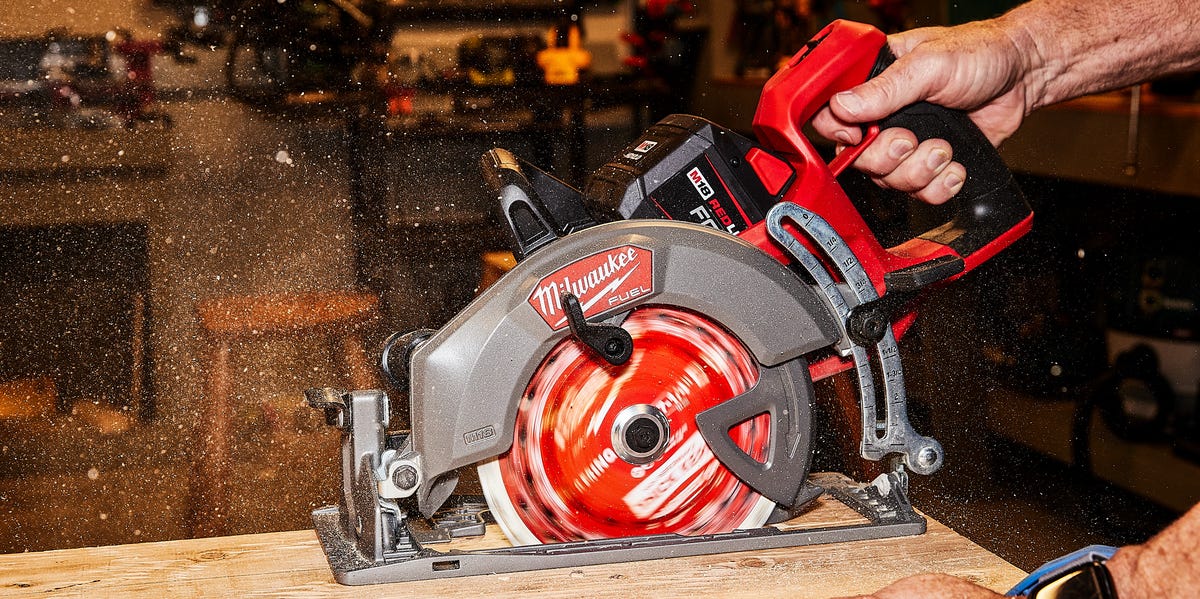
The Milwaukee 2930 Rear-Handle Circular Saw is the kind of tool that walks into a jobsite like it already knows where the coffee is. Officially known as the Milwaukee M18 FUEL 7-1/4-inch Rear Handle Circular Saw, model 2930-20, this cordless saw is built for professional carpenters, remodelers, framers, and serious DIYers who want corded-style confidence without dragging an extension cord across lumber, ladders, and everyone’s last nerve.
Popular Mechanics tested the Milwaukee 2930 in real-world cutting conditions and highlighted the things most users actually care about: power, visibility, balance, dust management, precision, and fatigue. That matters because circular saw marketing can get loud. Every saw claims it is “fast,” “powerful,” and “jobsite-ready.” The real question is whether it can rip through framing lumber, sheet goods, and repeated cuts without feeling like a gym punishment disguised as a tool.
After reviewing Milwaukee’s official product data, retailer specifications, independent tool coverage, and Popular Mechanics’ hands-on impressions, one thing is clear: the Milwaukee 2930 is not simply another battery-powered circular saw. It is Milwaukee’s serious attempt to make a rear-handle cordless saw that feels strong enough for demanding professional work while still improving visibility, dust control, and ergonomics.
What Is the Milwaukee 2930 Rear-Handle Circular Saw?
The Milwaukee 2930 is an 18V cordless rear-handle circular saw in the M18 FUEL lineup. It uses a 7-1/4-inch blade, a POWERSTATE brushless motor, REDLINK PLUS intelligence, and Milwaukee’s M18 REDLITHIUM battery platform. In plain English, this means it is designed to deliver high cutting speed, strong torque under load, and electronic protection against overheating or overload.
Rear-handle saws are often preferred by framers and carpenters because of their long body, familiar grip position, and line-of-sight advantages. They are commonly compared with worm-drive-style saws, although the Milwaukee 2930 is a cordless, modernized version of that jobsite-friendly layout. The result is a saw that feels built for long rips, crosscuts, framing lumber, plywood, OSB, rafters, decking, and other construction materials.
Key Specifications at a Glance
- Model: Milwaukee 2930-20
- Platform: M18 FUEL cordless system
- Blade size: 7-1/4 inches
- Blade type included: 24-tooth framing blade
- No-load speed: About 6,000 RPM, with some retailer listings showing 6,300 RPM
- Maximum cut depth at 90 degrees: 2-5/8 inches
- Maximum cut depth at 45 degrees: 2 inches
- Bevel capacity: Up to about 53 degrees depending on listing and configuration details
- Weight: About 8.3 pounds bare tool and about 11.6 pounds with an M18 FORGE HD12.0 battery
- Runtime claim: Up to 700 cuts per charge with an M18 REDLITHIUM FORGE HD12.0 battery
Those numbers place the Milwaukee 2930 among the most capable cordless rear-handle circular saws currently available. But numbers only tell part of the story. A saw can look impressive on paper and still feel awkward, nose-heavy, or fussy once the blade meets wood. That is where the Popular Mechanics test becomes useful.
Popular Mechanics’ Test: What Stood Out?
Popular Mechanics praised the Milwaukee 2930 for its high torque, cutting confidence, clear blade-to-line visibility, dust port placement, and LED position. The review also noted a realistic downside: arm fatigue. That is not shocking. A rear-handle saw with a large battery and professional build quality is not going to feel like a feather. It is more like a compact bulldog with a blade.
The big takeaway from the testing is that the saw performs like a premium cordless tool rather than a “pretty good for battery-powered” compromise. It tracks well, cuts cleanly, and maintains confidence through demanding material. That is especially important for pros who need repeatable accuracy and speed, not just a saw that looks dramatic in a product photo.
Power and Cutting Performance
The Milwaukee 2930 is built around a brushless motor that helps maintain cutting speed under load. For users who frequently cut plywood, framing lumber, OSB, or rafters, this matters. A saw that bogs down halfway through a cut can leave burn marks, rough edges, and a mood that belongs in a weather warning.
In practical terms, the Milwaukee 2930 feels aimed at users who need a cordless saw that can replace or closely rival a corded rear-handle tool. It has enough cut depth to slice through common dimensional lumber in a single pass and enough speed to keep production moving. The 7-1/4-inch blade size also gives users access to a wide range of framing, ripping, finish, and specialty blades.
Why the 7-1/4-Inch Blade Matters
A 7-1/4-inch blade is the standard size many carpenters expect from a full-size circular saw. It offers a useful balance of cutting depth, blade availability, and jobsite versatility. Smaller cordless saws can be great for lighter tasks, but when you are cutting 2x material, thick sheet goods, or framing components, a full-size blade provides more flexibility.
Visibility: A Major Win for the Milwaukee 2930
One of the strongest points mentioned in the Popular Mechanics review is blade-to-line visibility. This is not a small detail. If you cannot clearly see your cut line, the saw can have all the horsepower in the world and still make you feel like you are guessing your way through a geometry exam.
Milwaukee’s placement of the dust port and LED helps keep the cut line easier to follow. The left-blade orientation also gives many right-handed users a clearer view of the blade and mark. For framers and remodelers working quickly, that visibility can translate into cleaner cuts, less rework, and fewer muttered apologies to expensive plywood.
Dust Porting and Cleaner Cuts
Dust management is another area where the Milwaukee 2930 earns attention. Circular saws are not usually famous for tidiness. Most of them treat sawdust like confetti at a lumber-themed parade. But this model’s dust port design is more thoughtful than average, helping direct debris away from the cut line and improving overall control.
The included dust plug and vacuum adapter make the saw more flexible for different work situations. On an open framing site, users may prioritize speed and visibility. In a remodeling environment, especially indoors or near finished surfaces, connecting dust collection can make the work cleaner and more professional.
Ergonomics: Strong, Balanced, but Not Weightless
The Milwaukee 2930 weighs about 8.3 pounds as a bare tool and around 11.6 pounds with a large HD12.0 battery. That weight is not unusual for a high-performance rear-handle saw, but it is noticeable during extended overhead, awkward-angle, or repetitive cutting. Popular Mechanics called out arm fatigue as the main trade-off, and that is fair.
However, weight alone does not define comfort. Balance, handle shape, trigger placement, shoe stability, and line-of-sight design all affect how tiring a saw feels. The Milwaukee 2930 has a long rear-handle layout that many users find natural for pushing through longer cuts. The rafter hook also adds jobsite convenience when the saw needs to be set down safely between tasks.
Battery Platform and Runtime
Milwaukee claims up to 700 cuts per charge when the saw is paired with an M18 REDLITHIUM FORGE HD12.0 battery. As always, real-world runtime depends on material, blade condition, cutting depth, feed rate, temperature, and how aggressively the saw is used. Cutting thin sheet goods is not the same as repeatedly cutting thick framing lumber.
The bigger advantage is platform compatibility. Users already invested in Milwaukee’s M18 system can use existing M18 batteries, although the best performance will come from higher-output packs. For contractors who already own drills, impact drivers, grinders, nailers, and lighting on the M18 platform, the 2930 fits naturally into the ecosystem.
Milwaukee 2930 vs. Older Rear-Handle Saws
Compared with earlier cordless rear-handle designs, the Milwaukee 2930 focuses on more power, better weight management, improved visibility, and smarter dust routing. Milwaukee’s official material positions it as lighter than the previous generation while maintaining serious cutting performance. That combination matters because rear-handle saws have historically been powerful but not always friendly to shoulders and wrists.
The 2930 does not magically erase the physical demands of using a full-size saw. It is still a professional tool, not a toy. But it shows how far cordless circular saws have come. A decade ago, many users treated cordless circular saws as backup tools. Today, a model like the Milwaukee 2930 can credibly serve as a primary saw for many framing and remodeling jobs.
Who Should Buy the Milwaukee 2930?
The Milwaukee 2930 Rear-Handle Circular Saw is best for professional carpenters, framers, remodelers, deck builders, and advanced DIY users who need cordless power without giving up full-size cutting capacity. It is especially appealing if you already own Milwaukee M18 batteries and want a saw that can handle demanding work.
Best Fit For
- Framing lumber and structural cuts
- Plywood, OSB, and subfloor work
- Deck framing and outdoor construction
- Remodeling projects where cordless mobility matters
- Users who value cut-line visibility and dust control
Not the Best Fit For
- Casual users who only make occasional light cuts
- People who want the lightest possible circular saw
- Budget shoppers who do not already own M18 batteries
- Small trim tasks where a compact saw would be easier to handle
Pros and Cons
Pros
- Excellent cutting power for a cordless circular saw
- Full-size 7-1/4-inch blade capacity
- Strong cut-line visibility
- Thoughtful dust port placement
- Compatible with Milwaukee M18 batteries
- Professional build quality and jobsite-ready features
- Useful rafter hook, LED light, and bevel/depth adjustments
Cons
- Can feel heavy during long cutting sessions
- Best performance requires a large, premium battery
- More saw than many casual homeowners need
- Premium price compared with entry-level circular saws
Buying Advice: Bare Tool or Kit?
The Milwaukee 2930 is commonly available as a bare tool, model 2930-20, and as part of a kit, such as model 2930-21HD. If you already have high-output M18 batteries and a charger, the bare tool may be the smarter buy. If you are new to the M18 platform or only own smaller batteries, the kit with the FORGE HD12.0 battery is more appealing because it unlocks the saw’s strongest performance.
A high-demand tool like this deserves a battery that can keep up. Pairing it with a small compact pack may work for light cuts, but it misses the point. That is like buying a pickup truck and feeding it scooter fuel. Technically interesting, practically questionable.
Real-World Experience: What It Feels Like to Use a Saw Like the Milwaukee 2930
Spending time with a rear-handle circular saw changes how you think about cutting lumber. A compact sidewinder can feel quick and handy, but a rear-handle saw has a different rhythm. It encourages a steady push, a longer sight line, and a more deliberate feel through the board. The Milwaukee 2930 fits that tradition, but with the freedom of a cordless platform.
The first thing most users notice is the confidence of the motor. When the blade enters plywood or framing lumber, the saw does not feel nervous. It has that “keep moving” attitude that matters when you are making repeated cuts. On a jobsite, hesitation costs time. A saw that holds speed helps the user focus on accuracy instead of babying the tool through every board.
The second thing is visibility. A good cut starts before the trigger is pulled. You mark the line, position the shoe, check your stance, and guide the saw through the material. When the blade and cut line are easier to see, the whole process feels calmer. The Milwaukee 2930’s LED placement and dust-routing design help reduce the visual chaos that often comes with circular saw work. Less sawdust in the wrong place means fewer moments of “I’m pretty sure the line is somewhere under that wooden snowstorm.”
The third experience is the trade-off between power and fatigue. With the larger battery installed, the saw feels substantial. That is reassuring when cutting heavy material, but after many repeated cuts, your arm knows it has been invited to the party. This is not a flaw as much as a reality of professional cordless rear-handle saws. The weight comes with capacity, runtime, and stability. For long days, pacing, proper setup, and smart material support make a noticeable difference.
Another practical point is how well this saw fits into a workflow. The rafter hook is not glamorous, but it is extremely useful. Being able to hang the saw securely between cuts keeps it accessible and off the floor. The bevel and depth adjustments also matter more than they seem. On a good saw, adjustments feel positive and readable. On a frustrating saw, every setting change feels like negotiating with a tiny metal goblin. The Milwaukee 2930 leans toward the professional side of that equation.
For remodelers, dust collection compatibility may be one of the most underrated features. Cutting outdoors is one thing. Cutting inside a home, garage, basement, or partially finished space is another. Any improvement in dust control helps keep the workspace cleaner and the customer happier. Nobody wants a beautiful new project wrapped in a fine layer of “oops.”
For DIY users, the Milwaukee 2930 may be more tool than necessary, but that does not mean it is unappealing. If you build decks, sheds, workbenches, garden structures, or frequent home improvement projects, a powerful cordless saw can make the work smoother. The key is being honest about your needs. If you only cut a few boards per year, a lighter and less expensive saw may make more sense. If you regularly tackle large projects, the 2930 starts to look like an investment rather than a splurge.
The best way to describe the Milwaukee 2930 is this: it feels like a serious saw designed by people who understand what slows users down. It improves visibility, manages dust more intelligently, delivers strong power, and fits into Milwaukee’s popular M18 battery ecosystem. It is not the lightest tool in the aisle, and it is not trying to be. It is built for users who want cordless mobility without losing the authority of a full-size rear-handle circular saw.
Final Verdict
The Milwaukee 2930 Rear-Handle Circular Saw earns its attention because it combines power, precision, and cordless convenience in a package that feels genuinely jobsite-ready. Popular Mechanics’ testing reinforces what the specs suggest: this saw is powerful, accurate, and thoughtfully designed, with excellent cut-line visibility and dust management. The main drawback is weight-related fatigue, especially with a large battery installed, but that is a reasonable trade-off for the performance level.
For professionals already in the Milwaukee M18 system, the 2930 is one of the strongest cordless circular saw options to consider. For serious DIYers, it is a premium upgrade that can make large projects feel more controlled and efficient. It is not a casual bargain-bin saw. It is a workhorse with a red paint job and just enough attitude to make plywood nervous.
Note: This article synthesizes publicly available product specifications, hands-on review findings, retailer data, and independent tool coverage from reputable U.S. sources. No outbound source links are included, as requested.