Note: This guide is written for educational use and assumes you are working on a classic air-cooled Volkswagen Beetle with a Solex-style 34 PICT-3 carburetor. Because gasoline, hot engines, and moving parts are involved, work with an experienced adult or qualified mechanic, keep sparks and cigarettes far away, and stop immediately if you see fuel leaking.
The 34 PICT-3 carburetor is one of those charming Volkswagen parts that looks simple until it decides to behave like a tiny brass riddle with a choke. Found on many late air-cooled VW Beetles, Super Beetles, Ghias, Buses, and countless swapped engines, the 34 PICT-3 is reliable when it is clean, sealed, and adjusted correctly. When it is not, it can create rough idle, stalling at stop signs, hard starting, hesitation, rich running, and the kind of driveway frustration that makes a person stare silently into the engine bay like it owes them rent.
The good news: setting the 34 PICT-3 carburetor is not black magic. It is a careful sequence. The bad news: skipping the basics usually makes the adjustment fail. A carburetor cannot compensate for tight valves, bad ignition timing, vacuum leaks, a stuck choke, a clogged idle jet, or a throttle cable that is holding the butterfly open. In other words, do not blame the carburetor until the rest of the engine has stopped acting suspicious.
This guide explains how to set the 34 PICT-3 carburetor on an air-cooled Volkswagen Beetle, including the fast idle screw, volume control screw, bypass screw, idle speed, mixture adjustment, choke checks, accelerator pump basics, and troubleshooting tips. Think of it as a friendly garage manual with fewer greasy fingerprints and slightly more personality.
What the 34 PICT-3 Carburetor Actually Does
The 34 PICT-3 is a single-barrel downdraft carburetor designed to meter fuel and air for a classic VW flat-four engine. At cruising speeds, air moves through the throat of the carburetor, fuel is drawn through the main circuit, and the engine happily putters along like a mechanical sewing machine with opinions.
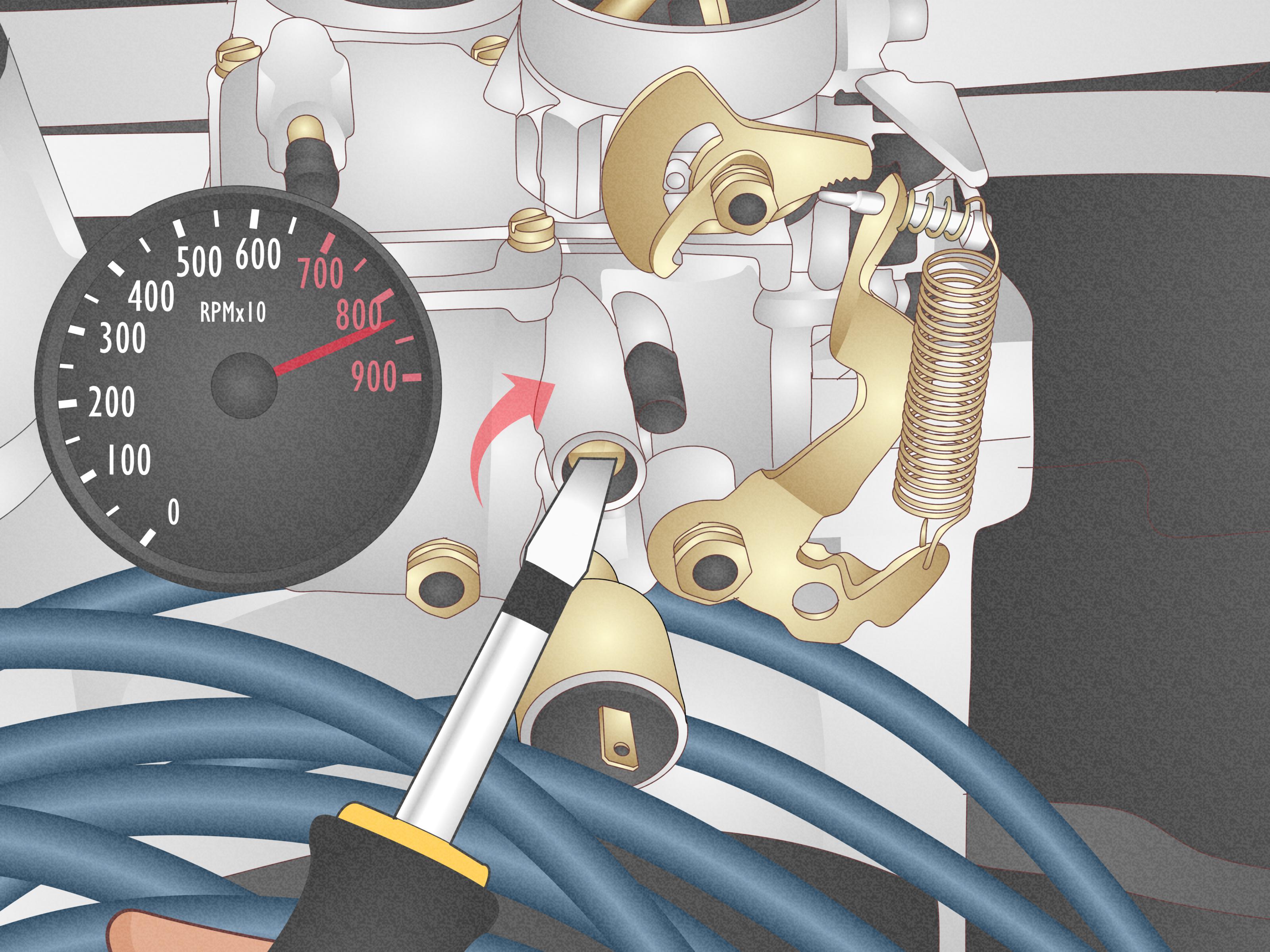
At idle, however, the throttle plate should be almost closed. The engine does not get its idle speed from the throttle arm screw like many people assume. Instead, the 34 PICT-3 uses a bypass circuit controlled by two screws on the left side of the carburetor:
- The large bypass screw controls the amount of air-fuel mixture bypassing the throttle plate and is used to set idle speed.
- The small volume control screw fine-tunes the idle mixture quality and helps you find the smoothest idle.
- The fast idle screw rests against the choke cam and is not used to set normal warm idle speed.
This last point is important enough to put on a garage poster: do not set warm idle speed with the fast idle screw. That screw only positions the throttle plate relative to the stepped choke cam. If you crank it in to raise idle, you may uncover the progression ports, confuse the idle circuit, create an off-idle stumble, and make future adjustment feel like arguing with a toaster.
Tools and Safety Items You Need
Before adjusting the VW 34 PICT-3 carburetor, gather the right tools. You do not need a race shop. You do need patience, a clean workspace, and a tachometer. Guessing idle speed by ear can work for someone who has tuned Volkswagens since bell-bottoms were new, but a tachometer saves time and reduces confusion.
- Flat-blade screwdriver
- Tachometer or dwell/tach meter
- Timing light
- Feeler gauge, usually around .003 to .004 inch for the fast idle screw setup
- Basic hand tools
- Carburetor cleaner for leak checks and cleaning, used carefully
- Shop rags
- Eye protection
- Fire extinguisher rated for fuel fires
Work in a ventilated area. Keep loose clothing, hair, and jewelry away from the fan belt and pulley. Never pour gasoline into the carburetor throat. If fuel is dripping, spraying, or pooling, stop and fix the leak before tuning. A Beetle should be air-cooled, not garage-flame-cooled.
Before You Touch the Carburetor: Do These Checks First
A 34 PICT-3 carburetor adjustment should be the final step in a basic tune-up, not the first thing you do because the engine is grumpy. If the engine has other problems, carburetor adjustments can hide the symptom for five minutes and then return with backup.
1. Adjust the valves
On a stock air-cooled VW engine with factory-style aluminum pushrods, valve clearance is commonly set at .006 inch when the engine is cold. Tight valves can cause poor idle, low compression symptoms, overheating, and hard starting. If the engine uses aftermarket chromoly pushrods, the clearance method may differ, so confirm what is installed before adjusting.
2. Set points, dwell, and ignition timing
The carburetor and distributor are dance partners. If one is stepping on the other’s shoes, the engine will stumble. Set dwell first if you use points, then set ignition timing according to your distributor type. Many SVDA-style distributors used with the 34 PICT-3 are commonly timed around 7.5 degrees BTDC at idle with the vacuum hose disconnected and plugged, but many centrifugal-only 009 distributors are usually set by total advance at higher rpm. Always identify your distributor before choosing a timing number.
3. Look for vacuum leaks
Vacuum leaks are the sneaky raccoons of air-cooled VW tuning. They can enter at the carburetor base gasket, throttle shaft, intake boots, manifold ends, brake booster hose on Bus applications, vacuum caps, or unused carburetor ports. A leak makes the mixture lean and often causes high idle, hanging rpm, popping, or a volume screw that refuses to respond normally.
4. Check the idle shut-off solenoid
The idle shut-off valve, also called the cut-off solenoid, should click when 12 volts are applied. If it does not open, the engine may refuse to idle even if the main circuit works. Make sure its wire is connected to the positive side of the ignition coil circuit and that the terminal is snug.
5. Confirm the choke opens fully
The electric choke should close when cold and open as the engine warms. Carburetor adjustment must be done with the engine fully warm and the choke butterfly standing open. If the choke is partly closed during adjustment, you will tune around a temporary condition and the engine may run poorly once warm.
Baseline Settings for the 34 PICT-3 Carburetor
Once the engine is mechanically healthy, use baseline carburetor settings to get close enough for fine-tuning. These settings are not the final destination; they are the starting line.
Fast idle screw baseline
Warm the engine, turn it off, and make sure the choke is fully open. The fast idle screw should rest on the lowest step of the stepped choke cam. Back the screw away from the cam, then bring it in until it just touches. Many Solex-style procedures use a tiny clearance around .003 inch and then turn the screw in slightly, commonly about one-half turn. Some aftermarket carburetor instructions specify a different final turn, so follow the instructions for your specific carburetor if they differ.
The key idea is simple: the throttle plate should be almost closed without binding in the bore. Do not use this screw to raise or lower your warm idle. That job belongs to the large bypass screw.
Volume control screw baseline
The small screw is the volume control screw. Turn it gently clockwise until it lightly seats. Do not crank it down like you are tightening a lug nut. The tip is delicate, and the carburetor body is softer than your frustration. After it seats, back it out about 2 1/2 turns.
Bypass screw baseline
The large screw is the bypass screw. Turn it gently clockwise until it seats, then back it out about 2 to 3 turns. This should allow the engine to start and idle well enough for final adjustment.
Step-by-Step: How to Set the 34 PICT-3 Carburetor
Step 1: Warm the engine completely
Start the engine and let it reach operating temperature. The choke must be fully open. Install the air cleaner and connect any breather hoses because the engine may idle differently with the air cleaner removed. If you tune it naked, so to speak, it may act differently once dressed for the road.
Step 2: Set initial idle speed with the large bypass screw
Connect your tachometer. Turn the large bypass screw slowly to set the idle speed near 850 to 900 rpm for most manual-transmission Beetle applications. Some automatic-stickshift or automatic-transmission applications may prefer a slightly higher idle, often around 900 to 950 rpm.
Turning the bypass screw inward usually lowers idle speed. Turning it outward usually raises idle speed. Move slowly and give the engine a moment to respond after each small adjustment.
Step 3: Adjust the small volume control screw for smoothest idle
Now turn the small volume control screw slowly. You are listening and watching for the highest, smoothest idle. Usually, turning it outward enriches the idle mixture and turning it inward leans it. Make tiny changes, about one-eighth to one-quarter turn at a time.
When the engine reaches its smoothest and fastest idle, turn the volume screw inward just enough for the rpm to drop slightly, often around 20 to 30 rpm. This gives a clean idle without leaving the mixture overly rich. If the engine wants the screw wildly far in or far out, something else may be wrong, such as a vacuum leak, blocked idle jet, incorrect jetting, or throttle plate position.
Step 4: Reset idle speed with the bypass screw
After adjusting the volume screw, return to the large bypass screw and set idle speed back to the target range. The two screws work together, so expect to go back and forth once or twice. That is normal. Carburetor tuning is not a single heroic twist; it is a polite negotiation.
Step 5: Blip the throttle and recheck
Briefly open the throttle and let the engine return to idle. The rpm should drop smoothly without stalling, hanging high, or dipping so low that the generator light winks at you. If the idle returns too slowly, check for vacuum leaks, sticky linkage, an overly tight throttle cable, or a choke cam that is not fully released.
Step 6: Road test carefully
After the driveway adjustment, road test the VW Beetle in a safe area. The engine should pull away from a stop without a big stumble, idle consistently at stoplights, and restart easily when warm. If the car hesitates sharply as you tip into the throttle, the issue may not be the idle mixture alone. Check accelerator pump action, distributor compatibility, timing, manifold heat, and vacuum leaks.
How to Check the Accelerator Pump
The accelerator pump gives the engine a quick squirt of fuel when you open the throttle. Without it, the engine can stumble because air moves faster than fuel for a moment. To check it, turn the engine off, remove the air cleaner, look down the carburetor throat, and operate the throttle arm. You should see a strong fuel stream begin immediately as the throttle moves.
Do this only with the engine off, in a ventilated area, with no ignition sources nearby. If the spray is delayed, weak, or aimed poorly, the accelerator pump linkage or nozzle may need attention. A well-adjusted accelerator pump can make the difference between a Beetle that leaves a stoplight smoothly and one that performs a dramatic cough for the audience.
Common Problems After 34 PICT-3 Adjustment
The engine will not idle unless the throttle is held open
First, listen for the idle shut-off solenoid click. Next, remove and clean the idle jet. Check that the small and large adjustment screws have good O-rings and are not damaged. Also inspect for vacuum leaks. If the idle circuit is blocked, no amount of screwdriver poetry will fix it.
The idle is too high even with the bypass screw turned in
Look for a throttle cable that is too tight, a fast idle screw resting on the wrong choke cam step, a vacuum leak, a throttle plate held open, or ignition timing that is too advanced at idle. Also check that unused vacuum ports are capped securely.
The volume screw does almost nothing
If the small screw has little effect, the engine may be getting air or fuel from somewhere it should not. Common suspects include vacuum leaks, throttle plate misadjustment, a clogged idle passage, worn throttle shaft bushings, or incorrect jets. The screw should have a noticeable effect when everything is healthy.
The car stumbles off idle
Off-idle hesitation can come from a lean idle setting, weak accelerator pump shot, clogged transition ports, poor manifold heat, distributor mismatch, or the famous 009 distributor flat spot. Many air-cooled VW owners find that the 34 PICT-3 works best with a proper vacuum-advance distributor, especially for street driving.
The engine runs rich and smells like fuel
Check the choke first. A choke that stays partly closed will make the engine rich. Also inspect float level, needle valve condition, fuel pressure, air filter restriction, and whether the volume screw is too far out. Sooty plugs, black exhaust smoke, and poor fuel economy are clues that the engine is drinking more than it needs.
Specific Example: A 1971 VW Super Beetle With Rough Idle
Imagine a 1971 Super Beetle with a 1600 dual-port engine and a 34 PICT-3 carburetor. The owner reports that it starts cold, idles fast, warms up, then stalls at every stop sign. The carburetor has already been adjusted three times, because naturally the screwdriver was blamed first.
A better diagnostic path would be:
- Adjust valves cold to the proper clearance.
- Check points and ignition timing.
- Verify the choke opens completely after warm-up.
- Listen for the idle shut-off solenoid click.
- Clean the idle jet.
- Check the carb base and intake boots for vacuum leaks.
- Reset the fast idle screw, volume screw, and bypass screw to baseline.
- Fine-tune warm idle to 850 to 900 rpm.
In many real garage situations, the fix is not one adjustment. It is two or three small corrections: a loose vacuum cap, a dirty idle jet, and a choke that was adjusted a little too rich. The carburetor was not broken; it was just surrounded by tiny chaos.
Maintenance Tips for Keeping the 34 PICT-3 Happy
Once tuned, the 34 PICT-3 does not need constant fiddling. In fact, constant fiddling often creates the very problems people are trying to solve. Keep the fuel clean, inspect vacuum hoses, service the air cleaner, maintain ignition parts, and avoid turning screws just because the engine had one moody morning.
If the car sits for long periods, modern fuel can leave varnish in small passages. A Beetle driven regularly often behaves better than one that hibernates for months. These engines like use, warmth, and attention. They do not love stale fuel and neglect, which is fair, because neither do lawn mowers or teenagers.
Real-World Experiences: Lessons From Setting the 34 PICT-3 Carburetor
The biggest lesson from working with the 34 PICT-3 carburetor is that the engine rewards order. If you jump straight to the mixture screw, the car may run better for a moment, but the improvement can vanish once the choke opens, the engine gets hot, or the vacuum leak changes with temperature. The proper sequence feels slower at first, but it saves time. Valves first, ignition second, vacuum leaks third, carburetor last. That rhythm has rescued more VW owners than any miracle fuel additive on a parts-store shelf.
Another practical experience is that the fast idle screw is often the accidental villain. Many Beetles arrive with that screw turned in too far because someone tried to raise the idle the way they would on another carburetor. On the 34 PICT-3, that creates trouble. The throttle plate opens too much, the idle circuit loses authority, and the bypass and volume screws stop behaving logically. Resetting the fast idle screw correctly can transform the adjustment from impossible to easy. It is one of those small details that makes you feel like a genius, even though the carburetor was simply asking to be treated the way it was designed.
Idle jets deserve respect, too. A tiny bit of debris can make the engine stall at every stop, yet the car may still rev if you keep your foot on the gas. That confuses beginners because fuel is obviously reaching the engine. The problem is that the idle circuit has its own tiny path, and that path must be clean. Removing the idle jet and blowing it clear is often more useful than turning the volume screw another three revolutions while muttering creative garage poetry.
Distributor matching is another experience that comes up repeatedly. A 34 PICT-3 paired with a good vacuum-advance distributor can feel smooth and friendly in normal driving. Pair it with a centrifugal-only 009 distributor, and some engines develop a flat spot when leaving a stop. Some owners tune around it with accelerator pump adjustment, jetting, and timing, while others switch to an SVDA-style distributor and wonder why they waited so long. The right answer depends on the engine, but the lesson is clear: carburetor tuning does not happen in isolation.
Finally, do not underestimate the air cleaner and preheat system. Many people tune with the air cleaner removed because it is convenient, then reinstall it and wonder why idle changed. The stock oil-bath or paper-element air cleaner, warm air pickup, and manifold heat system all help drivability, especially in cool or damp weather. A shiny chrome air cleaner may look like it belongs on a tiny race car, but it can remove useful factory engineering. Volkswagen was quirky, not clueless.
The best experience-based advice is simple: make one change at a time and write down your settings. Count turns. Note idle rpm. Record timing. Mark where you started. That way, if your adjustment makes things worse, you can return to the previous setup instead of wandering deeper into the maze. The 34 PICT-3 is not difficult when approached patiently. It simply refuses to be rushed, which is very on-brand for a classic Beetle.
Final Thoughts
Setting the 34 PICT-3 carburetor on an air-cooled Volkswagen Beetle is part science, part patience, and part learning to hear what the engine is telling you. The process begins before the screwdriver touches the carburetor: valves, ignition timing, choke operation, vacuum leaks, and idle solenoid function all matter. Once those basics are correct, the actual adjustment is straightforward. Set the fast idle screw correctly, baseline the volume and bypass screws, warm the engine fully, adjust the bypass screw for idle speed, fine-tune the volume screw for smoothness, and repeat until the engine idles cleanly.
A properly adjusted 34 PICT-3 will not turn a Beetle into a modern fuel-injected sedan, and honestly, that is part of the charm. But it should start reliably, idle smoothly, pull away without drama, and make that familiar air-cooled sound that convinces people to forgive the car for being older than some apartment buildings. Treat the carburetor with care, resist random screw-twisting, and your VW Beetle will reward you with miles of cheerful mechanical buzzing.