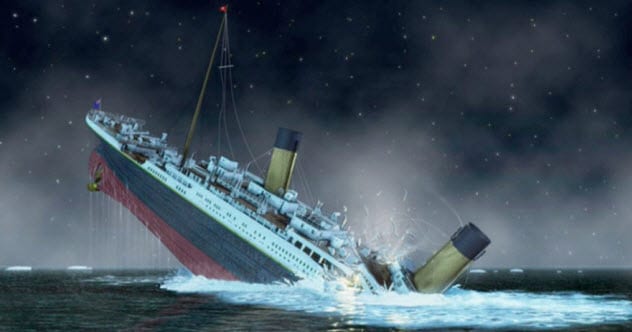
The iceberg delivered the blow, but it did not act alone. The sinking of the RMS Titanic was a chain-of-failure disaster involving speed, communication, visibility, construction choices, and a flooding-control system pushed beyond its design limits.
Shortly before midnight on April 14, 1912, Titanic struck an iceberg in the North Atlantic. Less than three hours later, the celebrated ocean liner disappeared beneath the water. More than 1,500 people died.
Saying “an iceberg sank Titanic” is accurate in roughly the same way that saying “gravity broke the dropped plate” is accurate. It identifies the final physical event while skipping nearly every decision and vulnerability that made the event catastrophic.
Titanic was not a flimsy ship assembled with wishful thinking and decorative glue. It was an advanced vessel for its era. Its safety features included watertight doors, a double bottom, pumps, and 16 major watertight compartments. Nevertheless, those systems were designed to withstand certain kinds of damagenot a long sequence of openings across several forward compartments.
The most convincing explanation is therefore not one secret defect or colorful conspiracy. It is a combination of human judgment, environmental conditions, communication failures, and engineering limitations. Here are 10 reasons the Titanic sank besides the iceberg itself.
1. The Ship Maintained a Dangerously High Speed
Titanic was traveling at about 22 knots as it approached a region where other ships had reported ice. That was close to its normal service speed. Although maintaining speed in clear weather was common practice among experienced captains of the period, the practice left very little margin for error.
Captain Edward Smith and his officers knew that ice had been reported along or near the ship’s route. They appear to have expected that the lookouts would spot any obstacle early enough for Titanic to avoid it. That assumption workedright up until it spectacularly did not.
A ship as large as Titanic could not turn or stop like a modern automobile. At 22 knots, it traveled hundreds of yards in less than a minute. Once the iceberg became visible, the officers had only seconds to interpret the danger, issue orders, and wait for an enormous mechanical system to respond.
The British inquiry ultimately identified excessive speed in icy waters as a central cause of the collision. A slower approach would not have guaranteed safety, but it would have increased the available reaction time and reduced the force placed on the hull.
2. Ice Warnings Did Not Produce Decisive Action
Titanic received several wireless messages about ice on April 14. Some warnings reached the bridge, and Captain Smith even showed one to Bruce Ismay, chairman of the White Star Line. Other reports were delayed, handled as routine traffic, or never delivered to the officers responsible for navigation.
The problem was not that everyone aboard had mysteriously forgotten ice existed. The deeper failure was that scattered reports never became a shared, urgent picture of the danger ahead.
One message from the steamship Mesaba described a large field of ice directly along Titanic’s route. Because it was not marked in a way that required personal acknowledgment by the captain, it remained in the wireless room. Later, the nearby Californian attempted to report that it had stopped because of ice. Titanic’s busy operator interrupted the transmission while working on passenger messages.
Each communication decision seemed manageable in isolation. Together, they left the bridge without the strongest possible warning that the ship was approaching an extensive ice field at high speed.
3. The Wireless Communication System Had Serious Limitations
Wireless telegraphy was still relatively new in 1912. Titanic’s Marconi operators, Jack Phillips and Harold Bride, were not bridge officers. They were employed primarily to transmit commercial messages, although they also handled navigational and emergency traffic.
After repairing a broken wireless set, the operators faced a large backlog of passenger telegrams. Phillips was communicating with the station at Cape Race when the Californian’s operator sent his nearby-ice message. The strong signal interrupted Phillips, who responded sharply and continued clearing his backlog.
This incident is sometimes presented as one careless operator ignoring a perfectly labeled emergency warning. Reality was messier. Wireless messages had different levels of priority, procedures were inconsistent, and ice reports were not always treated as direct orders to the bridge.
Technology had allowed ships to exchange information across great distances, but operating culture had not fully caught up. Titanic possessed valuable warning data without having a reliable system for turning all of that data into immediate navigational action.
4. The Night Made the Iceberg Unusually Difficult to See
The sea was exceptionally calm, and there was no moon. Those conditions produced a beautiful night for passengers and a terrible one for iceberg detection.
Lookouts often spotted an iceberg because waves broke against its base, creating a line of pale foam. On a flat, nearly windless sea, there was little or no surf to reveal the obstacle. Without moonlight, the iceberg also lacked a bright outline. It appeared mainly as a dark shape blocking part of the starry horizon.
Cold-water refraction may also have affected the horizon, although the importance of this atmospheric effect remains debated. Layers of cold and warmer air can distort distant objects or create a hazy boundary between sea and sky. Even without an unusual mirage, the documented darkness and calm water made the iceberg much harder to identify.
In other words, Titanic encountered an obstacle that was large enough to sink a ship but visually polite enough not to announce itself until the last moment.
5. The Lookout System Lacked Useful Backup
Lookouts Frederick Fleet and Reginald Lee were stationed in the crow’s nest, but they did not have binoculars. A locker containing binoculars was reportedly left inaccessible after a last-minute crew reassignment before the voyage.
Fleet later testified that binoculars might have helped him identify the iceberg sooner. However, historians and navigation experts disagree about how much difference they would have made. Binoculars provide a narrow field of view and are generally more useful for examining an object after it has been detected than for continuously scanning a dark horizon.
The missing binoculars should therefore not be treated as the magic object that would certainly have saved Titanic. The more important issue was the absence of additional precautions. Despite repeated ice reports, the ship did not substantially slow down or create a dramatically strengthened lookout system.
Human vision remained the primary detection technology. On that moonless, calm night, it was being asked to perform a very difficult job with limited assistance.
6. The Crew Had Almost No Time to Maneuver
When Fleet finally saw the iceberg, he rang the warning bell and telephoned the bridge. First Officer William Murdoch ordered an evasive turn and changes to the engines. The exact sequence of engine orders has been debated, but the essential fact is clear: the iceberg was already extremely close.
Titanic’s rudder was adequate for normal navigation, yet no rudder could make an 882-foot liner pirouette like a figure skater. Its response depended on forward motion, water flow, engine behavior, and the time needed for mechanical orders to take effect.
The bow began to turn away, preventing a direct collision. Unfortunately, the starboard side swept along the submerged portion of the iceberg. The visible ice above the surface represented only a fraction of the obstacle’s total size.
Some writers argue that a head-on collision might have damaged fewer compartments, possibly allowing Titanic to remain afloat. That theory cannot be proven, and deliberately accepting a frontal crash would have seemed unthinkable to any officer on the bridge. Murdoch’s attempt to avoid the obstacle was a rational response made inside an impossibly small window.
7. The Collision Damaged Too Many Compartments
Popular illustrations once showed the iceberg cutting a gigantic 300-foot gash into Titanic. Later examination of the wreck and engineering calculations support a different picture: a series of relatively narrow openings formed along hull seams and affected several forward compartments.
The total open area may have been surprisingly small. What mattered was its distribution. Titanic could remain afloat with any two adjacent compartments flooded and, under certain conditions, with the first four forward compartments flooded. The collision compromised at least five and probably six.
That distinction was fatal. One large opening inside a limited area might have been contained. Multiple openings spread along the starboard bow defeated the ship’s carefully calculated reserve buoyancy.
Water entered the forward compartments faster than the pumps could remove it. The pumps were useful for leaks and controlling manageable flooding; they were never intended to win an argument with the North Atlantic after several sections of hull had opened simultaneously.
8. Some Iron Rivets May Have Failed Under Stress
Titanic’s hull plates were held together by millions of rivets. Steel rivets were used where hydraulic riveting machinery could reach, while workers installed wrought-iron rivets by hand in parts of the curved bow and stern.
Metallurgical studies of recovered rivets found elevated concentrations of slag, a glasslike residue within wrought iron. Excessive or unevenly distributed slag can make a rivet more likely to lose strength or fracture under a sudden load.
During the collision, pressure may have caused vulnerable rivet heads to break or rivets to pull from their holes. That would allow neighboring hull plates to separate at their seams, producing multiple narrow paths for seawater.
Researchers continue to debate how important the rivets were relative to hull deformation and other material failures. Titanic’s rivets were not uniformly defective, and the ship did not simply “come unbuttoned.” Still, evidence suggests that weaker iron fasteners in the bow may have helped turn contact with the iceberg into widespread flooding.
9. Cold Temperatures Affected the Ship’s Materials
Early-20th-century steel behaved differently from the carefully controlled marine steel used today. Tests on recovered Titanic hull material found relatively high levels of sulfur and phosphorus and showed that samples could become more brittle at ice-water temperatures.
Brittle materials absorb less energy before cracking. In the freezing North Atlantic, the ship’s steel and iron components were less forgiving than they would have been in warmer conditions.
That does not mean Titanic was built from obviously inferior steel. Some later research concluded that its hull steel was typical or even advanced for the period and possessed adequate strength for normal service. Metallurgists have often considered rivet quality a more plausible contributor than widespread shattering of the plates.
The balanced conclusion is that cold-sensitive material behavior may have influenced how the hull and its fasteners responded to extreme loading. It was probably an accomplice, not the mastermind.
10. The Watertight Design Could Not Stop Progressive Flooding
Titanic’s watertight doors were closed after the collision and appear to have worked largely as designed. The fatal limitation was above them.
The transverse bulkheads separating the compartments did not all extend high enough to prevent water from moving into the next section once the bow had been pulled downward. As the damaged forward compartments filled, their weight lowered the bow. Water then reached the tops of successive bulkheads and spilled aft into previously dry spaces.
The compartments were watertight across their lower sections, but they did not function as completely sealed boxes extending to the ship’s uppermost deck. Extending every barrier that high would have interfered with passenger movement, ventilation, cargo handling, and the luxurious open spaces expected aboard a major liner.
Titanic also had a double bottom rather than a complete double hull rising along its sides. The iceberg damaged the side of the vessel, where that extra protective layer did not exist. After the disaster, Titanic’s sister ship Olympic received higher bulkheads and an extended inner skinquiet confirmation that the original design had room for improvement.
What Did Not Actually Cause the Titanic to Sink?
Too Few Lifeboats
Titanic carried lifeboat space for only about half the people aboard, and several boats were launched below capacity. This did not cause the vessel to sink, but it greatly increased the death toll. The outdated regulations measured lifeboat requirements largely according to a ship’s tonnage category rather than requiring a seat for every person.
A Coal-Bunker Fire
A fire had burned in one of Titanic’s coal bunkers before and during part of the voyage. Some theories claim that it weakened a bulkhead or encouraged the ship to maintain speed. Most specialists do not regard it as a primary cause of the sinking. Coal fires were a known steamship hazard, and available evidence does not demonstrate that this one weakened the hull enough to determine the outcome.
The “Unsinkable” Label
Public confidence may have encouraged complacency, but there is little evidence that White Star Line formally advertised Titanic as literally incapable of sinking before the disaster. Trade publications described the Olympic-class ships as “practically unsinkable,” reflecting faith in their compartment system. The shortened version became famous after the wreck, when irony took over the marketing department.
Conclusion: Titanic Was a Chain-of-Failure Disaster
The iceberg was the immediate trigger, but Titanic sank because its speed, warning procedures, visibility conditions, maneuvering limits, materials, and flooding-control design aligned in the worst possible way.
Remove just one link from that chain and the outcome might have changed. A slower ship could have turned sooner. A warning delivered directly to the bridge might have produced a course change. Taller bulkheads could have delayed progressive flooding. Stronger seams might have reduced the amount of incoming water.
No single improvement guarantees that Titanic would have reached New York safely. Together, however, these factors explain why a glancing collision became one of history’s most devastating maritime disasters. The lasting lesson is uncomfortable but valuable: advanced technology cannot compensate for every assumption, especially when several small weaknesses decide to hold a meeting at the same time.
Experiencing Titanic’s Lessons: What the Disaster Means in Human Terms
To understand the Titanic disaster, imagine the experience before imagining the wreck. For most passengers, the voyage had been calm, comfortable, and astonishingly luxurious. Electric lights illuminated elegant public rooms. Elevators carried guests between decks. Meals arrived in courses. Even third-class accommodations compared favorably with those on many contemporary ships. Nothing about the evening suggested that the most advanced moving object many passengers had ever seen was approaching mortal danger.
That normality helps explain why the first stages of the emergency were confusing. The collision was not necessarily experienced as a cinematic explosion. Some passengers felt a vibration, a scraping sensation, or a slight interruption in the engines. A few reportedly compared the disturbance to running over a thousand marbles. There was no instant plunge and no giant wall of water charging through every corridor.
People opened cabin doors, asked stewards what had happened, and waited for instructions. Some returned to bed. Others went outside and played with pieces of ice scattered on the forward deck. The ship appeared stable, the electric lights remained on, and the night was bitterly cold. Entering a small open lifeboat seemed less sensible than remaining aboard a brilliantly illuminated liner that everyone believed was exceptionally safe.
Crew members experienced a different reality below deck. Engineers, stokers, electricians, and seamen worked around incoming water, machinery, steam, and closing doors. The ship’s pumps could slow flooding in some areas, but they could not overcome the volume entering the damaged compartments. Many crewmen remained at their posts to preserve electricity and buy time for the evacuation.
On the boat deck, the disaster became a lesson in how people respond to incomplete information. Officers knew lifeboat capacity was limited, but passengers were initially reluctant to board. Some early boats left with empty seats because the situation did not yet feel terminal. Families faced confusing instructions, including varying interpretations of “women and children first.” Language barriers, unfamiliar corridors, class divisions, and the absence of a full passenger drill made movement more difficult.
As the bow settled lower, the experience changed. The slope of the decks became obvious. Furniture shifted. The forward well deck disappeared. What had seemed like an unnecessary precaution became a race for survival, except many of the lifeboats were already gone.
For those in the boats, survival brought another kind of experience: distance, darkness, and helplessness. They watched the ship’s lights remain visible until the electrical system finally failed. After Titanic broke apart and disappeared, the calm sea that had hidden the iceberg carried cries across the water. The temperature was low enough to cause rapid cold incapacitation and death.
Modern visitors encounter Titanic through museum artifacts, survivor testimony, photographs, wreck imagery, and films. The most meaningful experience is not simply staring at luxury objects or memorizing the ship’s dimensions. It is recognizing how familiar the pattern remains. People trusted a respected captain, advanced technology, established regulations, and an organization with years of experience. Each layer offered some protection, but none was perfect.
That is why Titanic continues to matter. Its story asks travelers, engineers, managers, and emergency planners an enduring question: What happens when a system faces a danger beyond the assumptions used to design it? The answer is not to distrust technology. It is to pair technology with clear communication, realistic drills, conservative judgment, and enough humility to prepare for the event everyone considers unlikely.