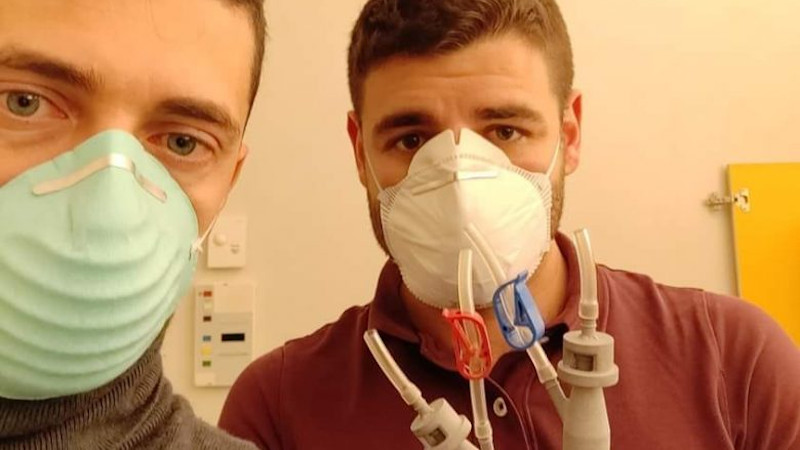
When COVID-19 slammed into hospitals in early 2020, the problem was not just the virus. It was the brutal math of shortages. Doctors needed protection, nurses needed protection, respiratory therapists needed protection, and the usual supply chains suddenly behaved like they had misplaced their car keys. N95 respirators were scarce, replacement parts were hard to find, and reusable equipment that normally sat in the background became mission-critical overnight.
That emergency pushed 3D printing, also called additive manufacturing, into the spotlight. Not as a sci-fi miracle machine that could print a whole hospital before lunch, but as a fast, flexible tool for solving very specific problems. It helped create adapters, frames, replacement pieces, face shield components, and reusable respirator shells when traditional manufacturers could not keep up. In many cases, those printed parts bought time, stretched limited supplies, and helped keep respirators operational during the worst days of the COVID-19 epidemic.
The real story is more interesting than the hype. 3D printing did not magically replace certified N95 production. It did something more practical: it filled gaps. It kept damaged or incomplete systems usable, supported local emergency production, and gave hospitals a way to move faster than conventional supply chains could. In a crisis, that kind of speed matters. Sometimes a small plastic adapter is not glamorous, but it can be the difference between a piece of respiratory protection working today or sitting uselessly on a cart like an expensive paperweight.
Why 3D Printing Mattered When Respirator Supplies Collapsed
COVID-19 exposed how fragile medical supply chains could be. Hospitals were hit by a perfect storm of just-in-time manufacturing, limited stockpiles, and dependence on globally sourced products. At the same time, the need for respiratory protection exploded. The CDC issued strategies to optimize the supply of N95 respirators, including extended use, contingency measures, and crisis-capacity planning. That alone tells you how severe the shortage became: the system moved from “use it once” to “we need a plan for making every respirator count.”
This is where 3D printing found its lane. Additive manufacturing is not always the cheapest or fastest way to make millions of identical items. But it is excellent when the need is immediate, the design must change quickly, and the part itself is relatively simple. A hospital, university lab, defense workshop, or local manufacturer could produce a prototype in hours, test it, adjust it, and print again. Traditional mass production is a freight train. 3D printing is a bicycle messenger. You do not use the bicycle to move a mountain, but when you need one critical package delivered right now, the bike suddenly looks pretty heroic.
That agility made printed parts useful for respirator-related problems. If straps snapped, if a connector was unavailable, if a reusable facepiece needed a redesigned frame, or if a filter adapter had to be tested quickly, 3D printing offered a path forward. It was not always pretty. It was rarely elegant. But during a pandemic, “available and validated” beats “perfect and back-ordered.”
What Kinds of 3D-Printed Parts Actually Helped?
Replacement Parts and Adapters
One of the most practical uses of 3D printing during the pandemic was producing rigid parts that could restore or extend the function of existing respiratory equipment. These included adapters, valves, filter mounts, and connector pieces. If the soft filter media was the soul of a respirator, the printed plastic part was often the skeleton that held everything together. That mattered because the difficult part of respiratory protection was not always the geometry of the mask body. It was sourcing the right filtration material and preserving a proper seal.
In other words, 3D printing could not simply replace the high-performance filtration technology inside a certified N95. But it could produce structural components around that filtration system or create interfaces that allowed a reusable device to accept available filters and cartridges. That is why many successful emergency designs focused on shells, frames, adapters, and accessories rather than pretending a desktop printer could recreate the entire performance profile of a commercially manufactured respirator out of thin air and good vibes.
Mask Frames and Strap-Saving Designs
Another smart use case involved 3D-printed frames designed to extend the life of N95 and KN95 respirators. During the shortage, many masks were still functional in terms of filtration but were less useful because the elastic bands broke or the fit degraded. Researchers and clinicians explored printed frames that could replace defective bands or improve the seal for some wearers. That is a deeply unglamorous innovation, which is usually a sign that it solved a real problem.
Instead of trying to reinvent the entire respirator, these designs focused on preserving what already worked. A frame could help a user keep a limited-supply mask in service a little longer, provided it still passed fit testing and met the institution’s safety requirements. This is a good example of what pandemic-era innovation looked like at its best: not flashy disruption, but practical repair.
Reusable Elastomeric Respirators
As the pandemic continued, reusable elastomeric respirators drew more attention. Unlike disposable filtering facepiece respirators, elastomeric models can be cleaned, disinfected, and reused when paired with appropriate filters or cartridges. During COVID-19, that reusability became a major advantage. Some organizations used 3D printing to prototype or manufacture parts of elastomeric half-mask respirators, especially the reusable frame or rigid shell components.
The U.S. Department of Defense described efforts to develop elastomeric half-mask respirators with reusable 3D-printed frames and disposable filtration media. That approach made sense because the hardest part to print was not the rigid housing. It was the filtration system and the need to meet regulatory performance standards. Reusable printed frames offered a way to reduce dependence on one-time-use products while still working within the logic of respiratory protection.
PAPR-Related Innovation
Powered air-purifying respirators, or PAPRs, also entered the conversation. PAPRs provide high levels of respiratory protection and became especially valuable in high-risk settings. Several teams worked on 3D-printable PAPR components or emergency-use designs, including low-cost systems intended for situations where commercial products were unavailable. These efforts showed that additive manufacturing could support advanced respiratory protection, but only when testing, airflow, filtration, and usability were taken seriously.
That last part is crucial. Respirators are not costume pieces. If a PAPR looks impressive but does not maintain the necessary airflow or filtration performance, it is not a clever workaround. It is a fancy way to make everyone nervous.
The Regulatory Reality: Helpful Tool, Not a Free Pass
The most responsible voices during the pandemic repeated the same message: 3D printing could help, but it had limits. The FDA warned that 3D-printed PPE might provide a physical barrier without delivering the same fluid resistance or air filtration performance as FDA-cleared surgical masks or N95 respirators. MIT experts echoed a similar concern, noting that poorly designed printed masks could create a false sense of security and that filter media, not just mask shape, was the real bottleneck.
That tension defined the entire story. On one hand, hospitals urgently needed equipment. On the other hand, medical devices exist in a world where “close enough” can be dangerous. Materials can be porous. Surfaces can be hard to sterilize. Small leaks can ruin a seal. Comfort matters because a respirator that fogs, pinches, or shifts around the face is not just annoying; it can be less protective. Fit testing also matters because a technically brilliant design is still a failure if it does not work on an actual human face.
This is why the most credible 3D-printing efforts relied on collaboration between engineers, clinicians, manufacturers, regulators, and testing labs. The FDA, NIH, the Department of Veterans Affairs, and America Makes helped build pathways for evaluating designs and sharing vetted files. That coordination turned a chaotic burst of maker enthusiasm into something more useful: a semi-organized emergency manufacturing ecosystem.
How Collaboration Kept Respirators and PPE Flowing
One of the biggest lessons from the COVID-19 epidemic was that good designs are only half the battle. The other half is knowing who needs them, who can manufacture them, and whether the final product is safe enough to use. Federal agencies and industry partners responded by creating a collaborative network that connected hospitals, designers, and manufacturers. NIH’s 3D Print Exchange became a repository for designs, while the COVID 3D TRUST initiative helped improve credibility and review emergency-use solutions.
That infrastructure mattered because 3D printing is inherently decentralized. A strength can also be a headache. Thousands of people can print something, but if every version is different and nobody knows which design has been reviewed, the result is confusion instead of relief. During the pandemic, centralized communication became just as important as printer capacity. A good file in the wrong hands is wasted effort. A mediocre file with no clinical review is worse.
America Makes and related federal reporting later showed just how large the response became. Between mid-February and mid-July 2020, U.S. additive-manufacturing efforts produced massive volumes of emergency items, including face shield parts, swabs, mask parts, and ventilator components. Respirator-related parts were only one slice of that wider response, but they demonstrate how additive manufacturing became a bridge technology during the peak of disruption.
Real-World Examples That Shaped the Narrative
Several examples from the United States help explain why this topic stuck in the public imagination.
At the University of Virginia, engineering teams responded to requests from frontline clinicians and worked on 3D-printed PPE solutions when local needs became urgent. MIT took a dual-track approach: its experts warned against assuming that 3D-printed masks were automatically safe, while other teams designed face shields intended for rapid, high-rate manufacturing. That combination of caution and creativity is basically the gold standard for crisis engineering.
The Defense Department pursued 3D-printed elastomeric respirator frames as a way to supplement exhausted supplies of disposable N95s. Meanwhile, academic teams studied printed N95 alternatives, mask frames, and emergency PAPR systems, reporting both the promise and the problems. Researchers found that airtightness, humidity, communication, fit, and decontamination all had to be addressed. Put simply, the part that comes off the printer is only the beginning of the story. The harder part is proving that the thing works when a tired clinician wears it for a full shift.
These examples also reveal a broader truth. The most useful 3D-printed respiratory devices were not always the most ambitious ones. Simple frames that rescued damaged masks, adapters that enabled existing systems to function, and reusable shells paired with appropriate filters often made more sense than trying to print a fully substitute respirator from scratch.
Why 3D Printing Worked Best as a Stopgap
Calling 3D printing a stopgap is not an insult. It is a compliment with realistic boundaries. A stopgap solution buys time during a supply emergency, especially when conventional production is disrupted. That is exactly what additive manufacturing did during COVID-19. It helped hospitals bridge dangerous gaps while larger manufacturers ramped up.
But there are good reasons it remained a stopgap for many respirator applications. Desktop and industrial printers alike face throughput limits. Printing is often slower per unit than injection molding or other mass-production methods. Quality can vary by machine, operator, material, and print settings. A file that works in one facility may behave differently in another. Medical production also requires documentation, consistency, sterilization protocols, and traceability. The printer may be fast, but the chain of trust takes longer to build.
Still, stopgaps save lives. In the first chaotic months of the pandemic, the ideal solution was often unavailable. Hospitals needed something that could be designed, reviewed, printed, and deployed locally. Additive manufacturing offered exactly that kind of flexibility. The trick was to pair urgency with discipline. The pandemic rewarded teams that moved fast without pretending that safety testing was optional.
Experiences From the Front Lines and the Workshop Floor
What did this look like in practice? For many clinicians, engineers, and volunteers, the experience was less like a smooth innovation pipeline and more like triage with laptops. A nurse would report a shortage, an engineer would sketch an adapter, a printer would run overnight, and somebody would walk the finished part over for evaluation the next morning. It was modern medicine meeting garage-shop improvisation in the hallway outside an ICU. Not exactly the workflow anyone had planned in business school.
In hospitals, the emotional pressure was enormous. Respiratory therapists and physicians were treating a virus that attacked the lungs, while the equipment designed to protect them was suddenly precious. A broken band on an N95 was no longer a minor inconvenience. It was a tiny mechanical failure with outsized consequences. That is why 3D-printed frames and replacement parts mattered so much. They addressed the kind of everyday damage that usually gets solved by opening a fresh box. During COVID, there often was no fresh box.
In university labs and makerspaces, the experience was equally intense, just with more filament and caffeine. Teams had to learn the language of health care fast. It was not enough to ask whether a printed part looked right. They had to ask whether it could be disinfected, whether it would tolerate repeated use, whether it would distort under heat, and whether clinicians could wear it comfortably for hours. A design that seemed brilliant at 2 a.m. sometimes fell apart after one stern conversation with an infection-control specialist, which, to be fair, is how many great ideas meet reality.
There was also a social lesson. The most successful efforts were rarely solo acts. They depended on clinicians who explained the problem clearly, engineers who respected medical constraints, and administrators who could move fast enough to support testing and deployment. The pandemic turned cross-disciplinary teamwork from a nice buzzword into a survival skill. Engineers needed medical judgment. Clinicians needed rapid fabrication. Manufacturers needed clear standards. Everyone needed patience, which was in almost as short supply as respirators.
Another common experience was discovering that the smallest improvements could have the biggest impact. A full redesign of a respirator might take weeks. A modest frame that restored fit or replaced broken straps could help immediately. A filter adapter could keep an existing reusable respirator in circulation. A printed shell could support a prototype for a better long-term product. These were not always headline-grabbing breakthroughs, but they were deeply practical. In a crisis, practicality is a kind of heroism.
Perhaps the most lasting experience was psychological. The people involved learned that local manufacturing capacity can calm panic. When supply chains crack, the ability to make even part of what you need nearby changes the mood. It does not solve everything, but it replaces helplessness with action. During the COVID-19 epidemic, 3D printing gave many hospitals and communities that feeling: not that they were invincible, but that they were no longer completely stuck waiting for a truck that might not arrive.
Conclusion
3D-printed parts helped keep respirators operational during the COVID-19 epidemic because they addressed urgent, practical failures in a broken system. They replaced damaged components, supported reusable respirator designs, enabled emergency adapters, and helped hospitals buy time while conventional manufacturers scaled up. The technology was not a magic replacement for certified respiratory protection, and the smartest experts never pretended otherwise.
What 3D printing proved was something arguably more important: in a public health emergency, flexible local manufacturing can strengthen resilience. When paired with clinical review, regulatory guidance, fit testing, and realistic expectations, additive manufacturing becomes a powerful emergency tool. The next pandemic may bring a different shortage, but the lesson will remain the same. Sometimes the most valuable innovation is not the shiny new gadget. It is the right small part, printed at the right moment, that keeps the protection working when people need it most.