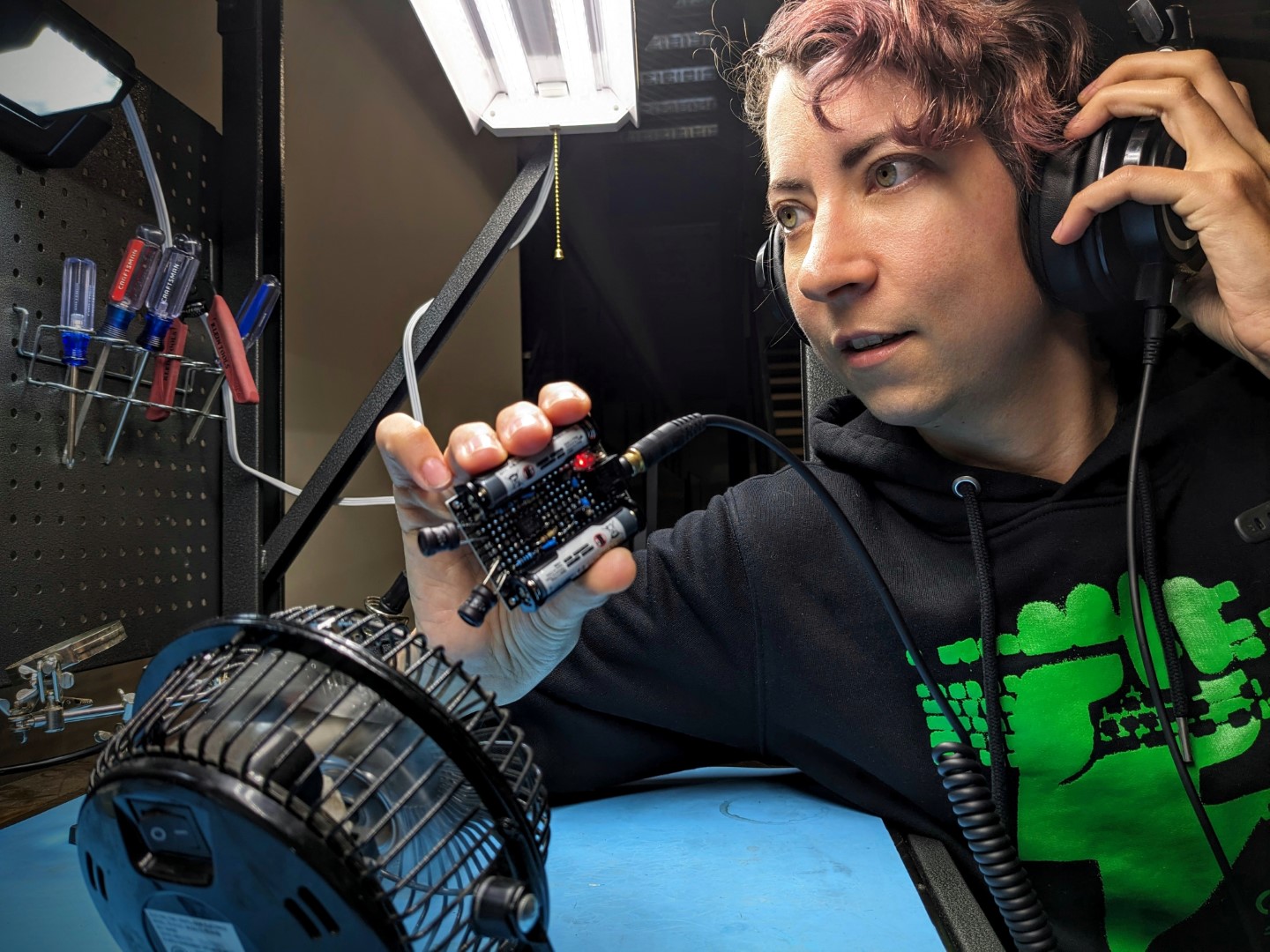
Our homes are full of electronic conversations we cannot normally hear. Laptop chargers pulse, LED lamps switch current on and off, phones negotiate with nearby networks, and kitchen appliances quietly produce changing electric and magnetic fields. To human ears, the room seems peaceful. To a sensitive coil and amplifier, however, it may sound like a robot orchestra tuning up inside a beehive.
The Electromagnetic Symphony project from Make: turns this invisible activity into audible sound. Instead of measuring electromagnetic fields with expensive laboratory equipment, the project uses a simple EMF audio amplifier to explore nearby electronics through headphones. It is part physics experiment, part soldering lesson, and part sound-art adventure.
Most importantly, it changes the way you experience technology. A phone is no longer merely a glowing rectangle demanding another software update. It becomes a landscape of clicks, pulses, buzzes, and rhythmic electronic textures waiting to be discovered.
What Is the EMF Universe?
An electromagnetic field, or EMF, is an area in which electrically charged particles experience electric or magnetic forces. Electric fields are associated with voltage, while magnetic fields are produced by moving electric charges, including current traveling through wires. When these fields change over time, they can induce voltage in nearby conductors and, under the right conditions, propagate energy as electromagnetic waves.
The complete electromagnetic spectrum extends from extremely long radio waves to microwaves, infrared, visible light, ultraviolet, X-rays, and gamma rays. Human vision detects only a tiny section of this enormous spectrum. Radio receivers, infrared cameras, medical imaging systems, satellite instruments, and other sensors reveal portions that our biological equipment forgot to include. Apparently, evolution decided opposable thumbs were enough.
An EMF Explorer does not let you hear the entire electromagnetic spectrum. It is not turning gamma rays into a catchy bass line or translating Wi-Fi directly into spoken messages. Instead, its coils respond mainly to changing magnetic fields nearby. The circuit then amplifies signal components that fall within, or create patterns within, the audible range.
How an EMF Audio Explorer Makes Invisible Fields Audible
The basic idea is beautifully simple: collect a tiny induced signal, amplify it, shape it, and send it to headphones. Each stage performs a specific job, and together they create a portable electronic stethoscope for machines.
The Inductor Becomes an Electromagnetic Microphone
The sensing element is an inductora tightly wound coil of conductive wire. When the magnetic field passing through the coil changes, a small voltage is induced across it. This is electromagnetic induction, the same broad physical principle used in generators, transformers, wireless charging systems, guitar pickups, and many other technologies.
A normal microphone responds to changes in air pressure. An inductor responds to changes in magnetic flux. That makes it useful for detecting low-frequency electromagnetic activity around motors, power supplies, displays, cables, chargers, and digital devices.
Orientation matters. Turn the coil ninety degrees, and a sound may become weaker, stronger, or disappear. Move it a few inches, and the electronic texture may change completely. The coil is therefore not just an on-or-off detector; it behaves more like a directional probe for exploring the shape and intensity of nearby fields.
The Op-Amp Gives Tiny Signals a Megaphone
The voltage induced in the sensing coil is usually far too weak to drive headphones directly. An operational amplifier, commonly called an op-amp, increases the signal to a usable level.
In the Make: design, the op-amp is configured as an inverting amplifier. Its gain is controlled primarily by the ratio between resistor values. Increasing the gain can reveal faint signals, but there is a tradeoff: excessive amplification also boosts noise and can push the circuit into clipping or instability. In other words, turning everything to eleven is not always scientific progress.
A dual-channel op-amp allows two sensing paths, making stereo exploration possible. Separate inductors can feed the left and right headphone channels, creating spatial differences as the device moves around an electronic object.
Capacitors Shape the Electronic Sound
Capacitors help couple, stabilize, and filter the amplified signal. Small capacitors can reduce unwanted high-frequency behavior around a high-gain amplifier, while larger optional capacitors can form a low-pass filter that softens harsh upper-frequency content.
Changing capacitor values alters the listening experience. One configuration may emphasize sharp digital clicks, while another favors slower hums and pulsing rhythms. This turns circuit modification into a form of sound design. Instead of choosing presets named “Concert Hall” or “Warm Vintage,” you are changing actual electronic components with a soldering iron.
What Makes the Make: EMF Explorer Project Special?
The Make: version is designed as an approachable, low-cost project that can be assembled over a weekend. Its core components include a protoboard, two inductors, a dual-channel op-amp, resistors, capacitors, two AAA batteries, battery holders, a switch, an indicator LED, and a stereo headphone jack.
The circuit is compact enough to become a wearable badge. That design choice matters because portability turns a bench experiment into an exploration tool. You can walk around a room, compare devices, map electronic hot spots, or use the detector as an unconventional instrument during a performance.
The project also connects engineering with visual art. A custom printed circuit board can use copper traces, solder-mask openings, and silkscreen graphics as artistic layers. The result is not simply a circuit hidden inside a plastic box. The electronics themselves become part of the object’s appearance and identity.
What Can You Hear with an EMF Detector?
Every device has a different combination of power conversion, digital processing, display control, motors, switching regulators, and communication hardware. Those systems often create recognizable electromagnetic patterns.
Chargers and Power Adapters
Modern switching power supplies rapidly control current to convert electricity efficiently. Near an adapter, an EMF audio amplifier may produce a steady buzz, a high-pitched whine, rhythmic ticking, or a sound that changes when the connected device begins charging.
Laptops and Computer Displays
A laptop can contain multiple sonic neighborhoods. The screen area may sound different from the keyboard, processor, cooling fan, battery-management circuitry, or charging port. Changes in brightness, workload, and power mode may alter the patterns you hear.
Phones and Wireless Devices
A phone may create clicks, bursts, buzzing patterns, or rapidly changing textures as its processor, display, power-management system, and radios become active. These sounds should not be interpreted as direct audio translations of wireless data. The detector is generally responding to local electronic activity, switching noise, modulation envelopes, and near-field coupling rather than decoding the radio carrier itself.
LED Lamps
LED bulbs often contain compact driver circuits that regulate power. Some produce a smooth hum, while others sound unexpectedly dramatic. A lamp that appears perfectly calm may be conducting an electronic argument worthy of daytime television.
Motors and Household Appliances
Fans, electric toothbrushes, refrigerators, pumps, and other motor-driven equipment can create strong, repetitive patterns. Their sound may vary with motor speed, control method, and mechanical load. Never open or probe a mains-powered appliance; listening from outside the intact enclosure is enough.
What This Project Teaches
Electromagnetic Induction Becomes Tangible
Faraday’s law can seem abstract when presented only as an equation. Moving an inductor around a charger and hearing the signal change makes induction immediate. The relationship among field strength, distance, direction, and coil orientation becomes something you can hear rather than merely memorize.
Signal Conditioning Matters
Sensors rarely produce perfect, ready-to-use output. Their signals often require amplification, filtering, biasing, and protection. The EMF Explorer demonstrates this complete signal chain in a compact circuit.
Electronic Devices Produce Distinct Signatures
The project introduces electromagnetic interference and electromagnetic compatibility in an intuitive way. Engineers carefully control unwanted emissions so products can operate without disrupting one another. A homemade detector reveals why shielding, grounding, filtering, cable layout, and circuit-board design are important.
Observation Is a Maker Skill
Building the detector is only half the activity. The next step is forming questions: Which part of a laptop produces the strongest sound? Does the pattern change on battery power? What happens when screen brightness changes? Does rotating the sensor alter the result?
Good experiments compare one variable at a time. Record the device, operating state, distance, coil orientation, and observed sound. That small habit transforms entertaining noise hunting into meaningful investigation.
Creative Ways to Expand the EMF Explorer
Create a Stereo Field Probe
Position two inductors at different angles or distances. Feed one into each headphone channel. The stereo image can make the electromagnetic environment feel wider and more directional.
Add a Visual Display
The audio output can be analyzed by a microcontroller or computer to create LED animations, level meters, spectrograms, or projected graphics. Sound becomes light, and invisible fields become an audiovisual performance.
Record an Electromagnetic Sample Library
Capture short recordings from chargers, screens, toys, printers, motors, and other devices. Label each sample carefully, then use the recordings in music production. A drum kit assembled from office equipment may not win a Grammy, but it will make the printer feel appreciated.
Experiment with Inductor Values
Different coils respond differently because of their inductance, resistance, construction, and physical geometry. Comparing several inductors can reveal how sensor choice affects sensitivity and tonal character.
Design a Custom Wearable PCB
Once the prototype works, recreate the circuit in PCB design software. Copper traces can become illustrations, decorative patterns, or visual representations of waves and magnetic fields. The finished board can function simultaneously as an instrument, badge, educational tool, and electronic artwork.
EMF Safety, Health, and Sensible Perspective
The term “radiation” can sound alarming, but electromagnetic radiation covers a huge range of frequencies and energies. Ionizing radiation, including X-rays and gamma rays, carries enough energy to damage atoms and biological molecules. Lower-frequency non-ionizing fields from household wiring, appliances, radio systems, and visible light behave differently.
Research organizations continue to study possible health effects associated with various forms and levels of EMF exposure. A homemade audio explorer cannot determine whether an environment is medically safe, verify regulatory compliance, or replace a calibrated instrument. Loud sounds in the headphones do not automatically mean dangerous exposure; they may simply indicate efficient coupling between the coil and a nearby low-frequency source.
For safe building and exploration, power the project only as designed with low-voltage batteries. Work on a heat-resistant surface, ventilate solder fumes, inspect polarized components carefully, and keep the circuit away from exposed mains voltage. Never insert probes into outlets, power supplies, microwave ovens, electrical panels, or damaged appliances. The universe is fascinating enough without becoming part of the circuit.
A Maker’s Listening Journal: Experiencing the Electromagnetic Symphony
The first few minutes with an EMF audio explorer can be confusing. You plug in the headphones, switch on the circuit, and hear little more than faint hiss. It is tempting to assume something is broken. Then the sensor approaches a laptop charger, and a dense buzzing tone suddenly fills the headphones. The invisible world has made its entrance, apparently without rehearsing.
A useful first experiment is to move the coil slowly along the charging cable. The sound is often strongest near the adapter and weaker farther away. Rotating the coil may reduce the buzz dramatically. That simple motion demonstrates that the detector is responding to a field with direction and structure, not to mysterious electronic “energy” floating uniformly through the room.
Next comes the laptop. Near the display, the sound may be thin and high. Around the keyboard or charging port, it may become louder and more complex. Launching an application, changing screen brightness, or connecting the charger can alter the texture. The computer begins to feel less like a single object and more like a small electronic city with districts operating on different schedules.
An LED desk lamp can provide another surprise. To the eye, its light appears steady. Through the detector, the driver circuit may reveal a sharp buzz or repetitive pulse. Dimming the lamp can change the rhythm, demonstrating that brightness control may involve rapid electrical switching rather than a simple reduction in continuous power.
A phone produces a more unpredictable session. While resting with the screen off, it may seem relatively quiet. Wake the display, start a download, activate the camera, or place it on a charger, and new bursts may appear. The exact result depends on the phone, its operating state, the sensor, and the surrounding electronics. The point is not to identify every internal process with certainty. The value lies in noticing that a device’s electromagnetic behavior changes as it performs different tasks.
After several objects, patterns begin to emerge. Power adapters often produce sustained tones. Motors tend to create repeating mechanical rhythms. Digital electronics may generate clicks, rapid pulses, and layered buzzing. Two products that perform the same job can sound very different because their internal circuits, switching frequencies, shielding, and physical layouts are different.
The most rewarding stage is turning exploration into composition. Record several short samples: a charger hum, a lamp buzz, a printer’s startup sequence, and the changing tone near a computer display. Trim the recordings, adjust their pitch, and arrange them into a beat. The final track may sound industrial, ambient, glitchy, or delightfully strange.
This experience changes everyday attention. Electronics no longer disappear into the background. You begin wondering what is happening inside a ticket machine, an electric bicycle charger, a digital sign, or a vending machine. The EMF Explorer does not provide complete technical answers, but it creates better questionsand that is often where real making begins.
Conclusion: A Portal into Everyday Electromagnetism
The Electromagnetic Symphony project transforms abstract physics into a hands-on sensory experience. With a pair of inductors, an op-amp, a few passive components, batteries, and headphones, makers can investigate electromagnetic induction, amplification, filtering, interference, sound design, and circuit construction.
Its greatest achievement is not merely producing unusual noises. It reveals that familiar objects contain active, changing systems that extend beyond what our eyes and ears naturally perceive. Once those hidden patterns become audible, a charger becomes an oscillator, a laptop becomes an electronic landscape, and an ordinary room becomes a laboratory.
Note: This project is intended for creative exploration and electronics education. It is not a calibrated EMF meter, medical device, or substitute for professional exposure testing. Use only low-voltage battery power and never probe exposed electrical wiring or mains-powered circuitry.
SEO Tags
Research synthesis: Make:, NASA, NIST, NOAA, U.S. Department of Energy, Harvard Natural Sciences, Exploratorium, The Physics Classroom, SparkFun, Adafruit, NIEHS, National Cancer Institute, and OSHA. Project design and operation: Electromagnetic spectrum and induction: Measurement, lightning, and EM behavior: Amplification and maker sensing: Health and safety context: